

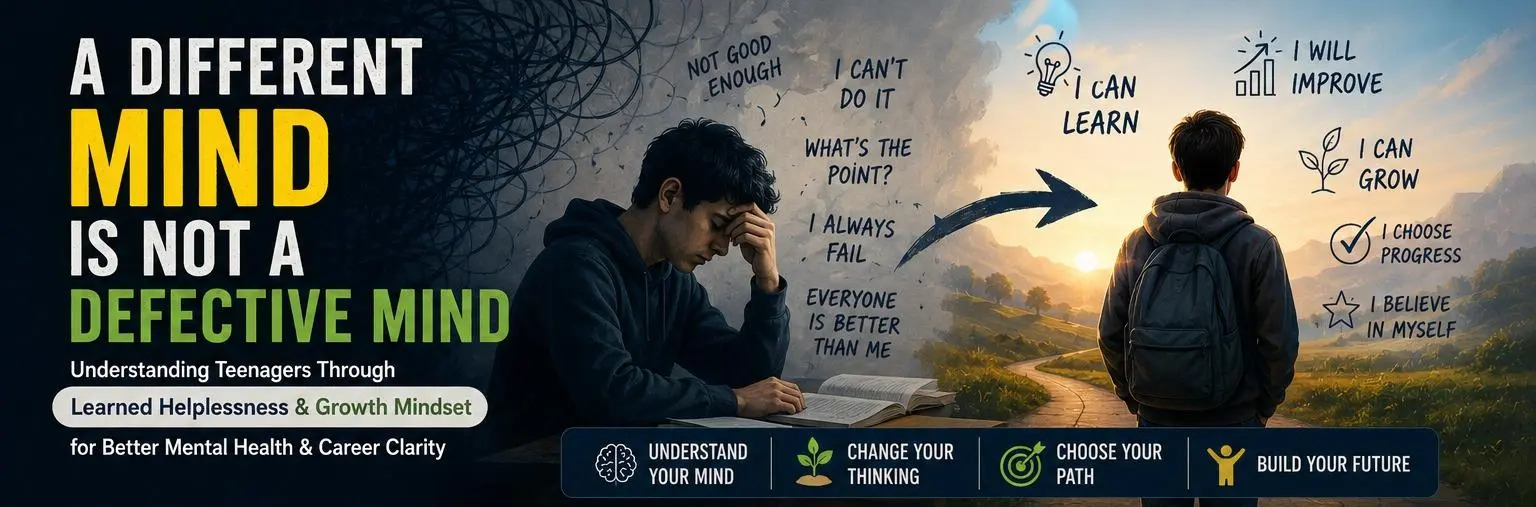
A Different Mind Is Not a Defective Mind
Today’s teenagers are constantly judged.
If they feel confused — they are called careless.
If they feel emotionally tired — they are called weak.
If they lose motivation — they are called lazy.
But many teenagers today are not weak.
They are mentally exhausted.
This generation is growing up in a world filled with:
- nonstop comparison,
- academic pressure,
- social media validation,
- fear about future careers,
- pressure to succeed early,
- and constant uncertainty.
Because of this, many students slowly stop believing in themselves.
And psychology explains why this happens.
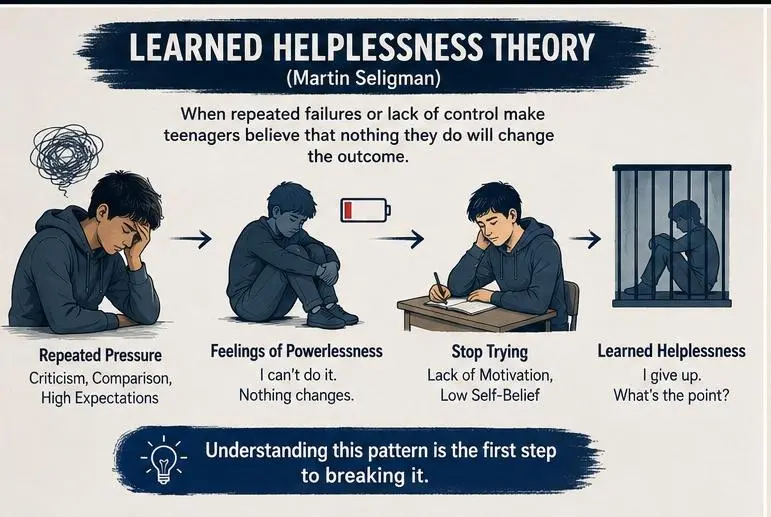
1: Learned Helplessness — “Nothing I Do Is Enough”
Learned Helplessness, developed by Martin Seligman, explains how people can stop trying after repeated feelings of failure, pressure, or lack of control.
After continuously hearing:
- “You are not good enough,”
- “Others are doing better,”
- “You must achieve more,”
- “This is not enough,”
many teenagers slowly develop thoughts like:
- “What’s the point of trying?”
- “I’ll fail anyway.”
- “Nothing changes even when I work hard.”
- “Maybe I’m just not capable.”
This emotional state is called learned helplessness.
And today, many students experience this silently.
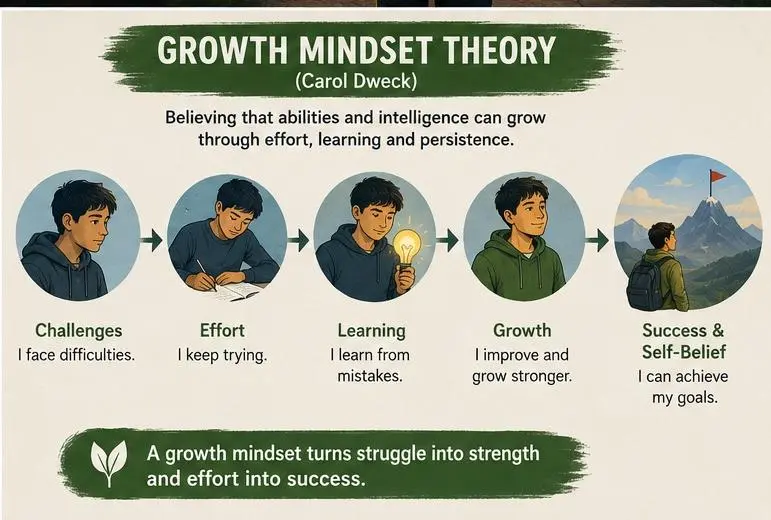
2: Growth Mindset — Intelligence Can Grow
Growth Mindset, developed by Carol Dweck, explains that abilities and intelligence are not fixed.
Students can improve through:
- effort,
- learning,
- adaptability,
- practice,
- and emotional resilience.
But many teenagers today grow up with a fixed mindset:
- “I’m either smart or not.”
- “Failure means I’m incapable.”
- “Others are naturally better than me.”
This creates fear of mistakes and emotional pressure.
Growth mindset changes this thinking completely.
Instead of:
“I failed, so I’m useless.”
Students learn:
“I struggled, but I can improve.”
This small shift changes emotional health deeply.
Modern Teenage Problems & Psychological Solutions
Problem 1: “I Feel Mentally Tired All the Time”
Many teenagers are emotionally exhausted even without physical work.
Psychological Reality:
Continuous pressure keeps the brain in survival mode.
Learned Helplessness Perspective:
Students begin believing:
“No matter what I do, it’s never enough.”
Solution:
Teenagers need realistic expectations, emotional support, and small achievable goals that rebuild confidence slowly.
Problem 2: “I’m Scared of Failure”
Today’s students fear failure more than learning.
Growth Mindset Perspective:
Many students think failure defines intelligence.
Solution:
Teach students:
- mistakes are part of growth,
- skills improve with practice,
- and success is a process, not instant perfection.
Problem 3: “I Don’t Feel Interested in Anything”
Many students suddenly lose motivation.
Psychological Reality:
This is often emotional burnout, not laziness.
Learned Helplessness Perspective:
When students repeatedly feel controlled, pressured, or compared, the mind slowly disconnects emotionally.
Solution:
Teenagers need:
- self-exploration,
- freedom to express interests,
- and environments where effort is appreciated, not only results.
Problem 4: “Everyone Else Is Better Than Me”
Social media has increased comparison culture deeply.
Psychological Reality:
Teenagers now compare their real life with other people’s highlight moments.
Growth Mindset Solution:
Instead of:
“I’m behind everyone.”
Teach:
“Growth happens differently for everyone.”
Progress becomes healthier when comparison decreases.
Problem 5: “I Feel Like My Future Is Uncertain”
Many teenagers today feel anxious about careers, money, and stability.
Psychological Reality:
This generation has grown up seeing competition and unpredictability everywhere.
Learned Helplessness Risk:
If students feel they have no control over life outcomes, they stop believing in their own efforts.
Solution:
Career counselling today should focus on:
- adaptability,
- skill development,
- emotional resilience,
- and flexible career growth.
Not only fixed career paths.
Problem 6: “I Feel Like Nobody Understands Me”
One of the biggest emotional struggles among teenagers today is feeling misunderstood.
Psychological Reality:
Teenagers often receive advice before receiving understanding.
Solution:
Listening without immediate judgment helps teenagers:
- trust themselves,
- communicate openly,
- and feel emotionally safe.
Sometimes emotional support itself becomes healing.
Why Modern Teenagers Need Psychological Understanding
Not every teenager needs strict discipline.
Some need:
- emotional safety,
- healthier thinking patterns,
- confidence rebuilding,
- realistic expectations,
- and understanding that career growth takes time.
Today’s students are emotionally overloaded, not emotionally weak.
And understanding this difference is extremely important.
Conclusion
A teenager who feels lost is not defective.
A student who struggles emotionally is not incapable.
And a child who loses motivation is not automatically lazy.
Learned Helplessness explains how repeated pressure can make students lose belief in themselves.
Growth Mindset explains how confidence and abilities can grow again with healthier thinking and support.
Together, these theories remind us:
Teenagers do not need constant pressure to grow.
They need understanding, emotional support, and the freedom to believe in themselves again.

Leave a Comment
To post comment, please