

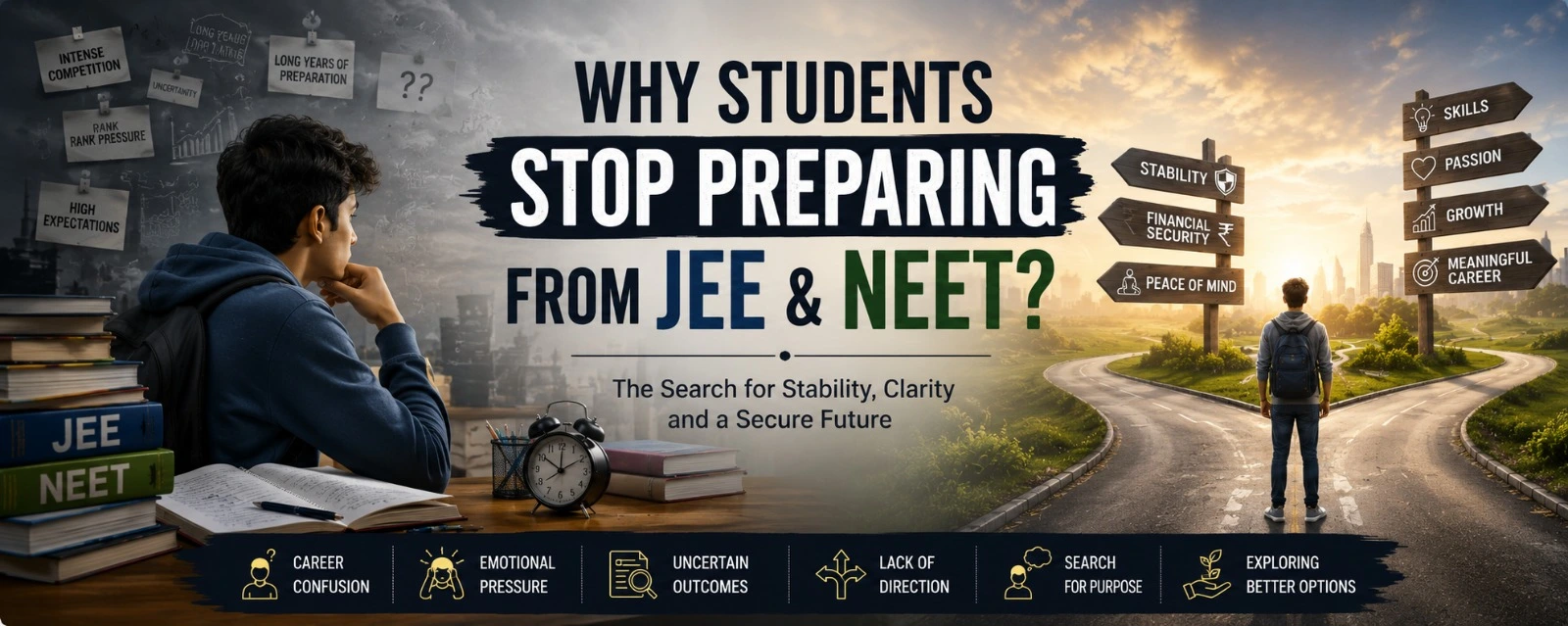
Why Students Are Leaving JEE & NEET Preparation
For many Indian families, two career paths are considered the “safe” options — engineering and medicine. From a very young age, students hear words like JEE, NEET, IIT, and MBBS almost everywhere around them. Coaching classes, relatives, schools, and society together create one message:
“If you crack these exams, your life is successful.”
But today, something is changing.
Many students are starting preparation for these exams with full dedication, yet slowly they stop in between. Some shift to different careers. Some lose motivation. Some realize they no longer want this life. And some simply feel emotionally exhausted.
The important question is:
Why are students leaving these competitive exams even after investing years of hard work?
The answer is much deeper than “difficulty.”
The New Generation Wants Stability, Not Just Prestige
Today’s 18–20-year-old student thinks very differently compared to previous generations.
This generation has grown up watching economic uncertainty, rising competition, changing industries, layoffs, social media pressure, and unstable career paths. Because of this, students today are not only asking:
“What is a respected career?”
They are asking:
“Will this career give me stability?”
“Will I become financially independent?”
“How many years will it take?”
“What if I fail after giving everything?”
This shift is very important.
Students today are not running only behind degrees. They are searching for security, peace of mind, and a predictable future.

The Emotional Pressure Behind JEE & NEET
Competitive exams in India are not just exams anymore. For many students, they become an identity.
Students spend 2–5 years preparing continuously. Daily schedules become limited to coaching, mock tests, rankings, and comparison. Slowly, many students stop enjoying learning itself. Education starts feeling like survival.
The pressure becomes heavier because success seats are limited while the number of aspirants keeps increasing every year.
A student begins to think:
“If I don’t clear this exam, what will happen to my future?”
This fear creates emotional burnout.
Not every student leaves because they lack capability. Many leave because they no longer feel emotionally connected to the process.
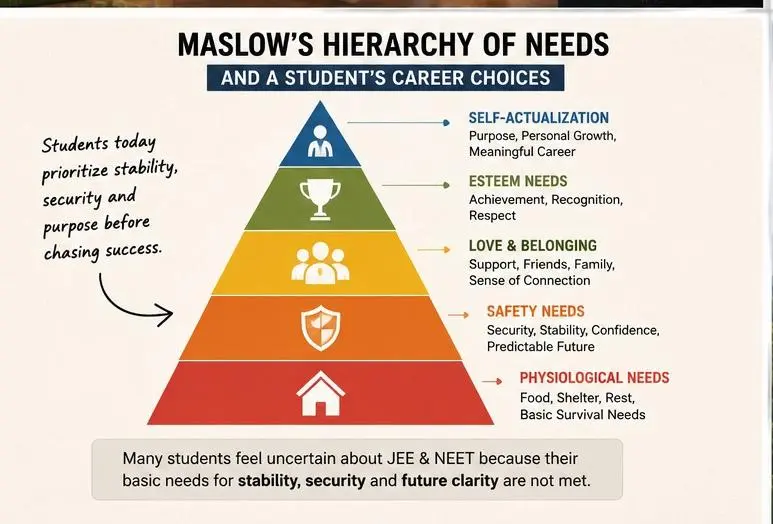
Maslow’s Need Theory and Career choice Choices
According to Maslow's hierarchy of needs, human beings first search for basic needs like safety, financial security, belongingness, and stability before reaching higher goals like achievement and self-actualization.
Today’s students are unconsciously making career decision decisions based on these needs.
A 20-year-old student wants:
- Financial independence
- Stable career growth
- Emotional balance
- Job opportunities
- Work-life stability
- Clear future direction
Many students feel that highly competitive exam systems no longer guarantee these needs in a predictable way. Even after years of preparation, there is uncertainty about admission, specialization, placements, and long-term career satisfaction.
Because of this, students start exploring alternative career paths that feel more flexible, skill-based, financially faster, and emotionally manageable.
The Problem Is Not Hard Work — It Is Uncertainty
Indian students are not afraid of hard work.
In fact, students preparing for JEE and NEET are among the most hardworking students in the country.
The real issue is uncertainty.
A student may spend years preparing without knowing:
- Whether they will get a seat
- Which college they will enter
- Whether they can afford education costs
- How long financial dependence will continue
- Whether the career will match their personality
When effort and future become disconnected, motivation naturally decreases.
Students today want careers where effort gives visible direction and growth.
Comparison Culture Is Quietly Affecting Students
One major reason students lose confidence during preparation is constant comparison.
Rank lists, coaching results, social media success stories, and family expectations make students feel that their worth depends only on performance.
But human potential cannot be measured by one exam alone.
Many students preparing for JEE or NEET are actually creative thinkers, entrepreneurs, designers, psychologists, writers, researchers, artists, business minds, or communicators. Yet they continue preparation because society labels only a few careers as “successful.”
This creates internal conflict.
And eventually, many students leave preparation not because they failed — but because they discovered they wanted a different life.
Career awareness Awareness in India Is Still Limited
Another major issue is lack of career awareness.
Many students know only a few mainstream professions:
- Engineering
- Medicine
- Government jobs
But the world has changed rapidly.
Today, careers exist in:
- Psychology
- Data science
- UX design
- Digital marketing
- AI and technology
- Content creation
- Entrepreneurship
- Finance
- International education
- Social sciences
- Environmental studies
- Media and communication
When students discover these fields later, many realize they were preparing for a career they never truly understood deeply.
This is why career counseling and aptitude guidance are becoming more important than ever.
Success Is No Longer One-Dimensional
Earlier, success was connected mainly to degrees.
Today, success is connected to:
- Skills
- Adaptability
- Financial growth
- Emotional well-being
- Networking
- Creativity
- Digital opportunities
- Personal satisfaction
Young people today are observing real-world examples where people build successful careers outside traditional paths.
This is changing the mindset of students across India.
What Students Actually Need Today
Students do not only need coaching.
They need:
- Career clarity
- Emotional support
- Skill development
- Exposure to different industries
- Financial education
- Realistic guidance
- Understanding parents and mentors
Most importantly, they need permission to explore careers without guilt.

Leave a Comment
To post comment, please