


“Choosing the Wrong Career Does Not Mean You Are Untalented”
A student once said during career counselling:
“Maybe I’m just not smart enough.”
He was preparing for a career path everyone around him considered “successful.” From outside, his life looked stable. He was attending coaching classes, studying regularly, and trying his best to stay focused. But internally, he felt emotionally disconnected from everything he was doing.
He constantly compared himself with others. Slowly, studying became stressful instead of meaningful. Even after working hard, he never truly felt confident or interested in the path he was following.
The problem was not that he lacked intelligence.
The problem was that his personality and career environment were completely different from each other.
And this is something thousands of students silently experience today.
Many students grow up believing that success means following careers society respects the most. Because of this, students often choose streams and professions based on:
- pressure,
- comparison,
- fear of instability,
- family expectations,
- or social status.
But very few students truly ask themselves:
“Does this career actually match who I am as a person?”
This is where Holland Codes becomes extremely important in understanding modern career confusion.
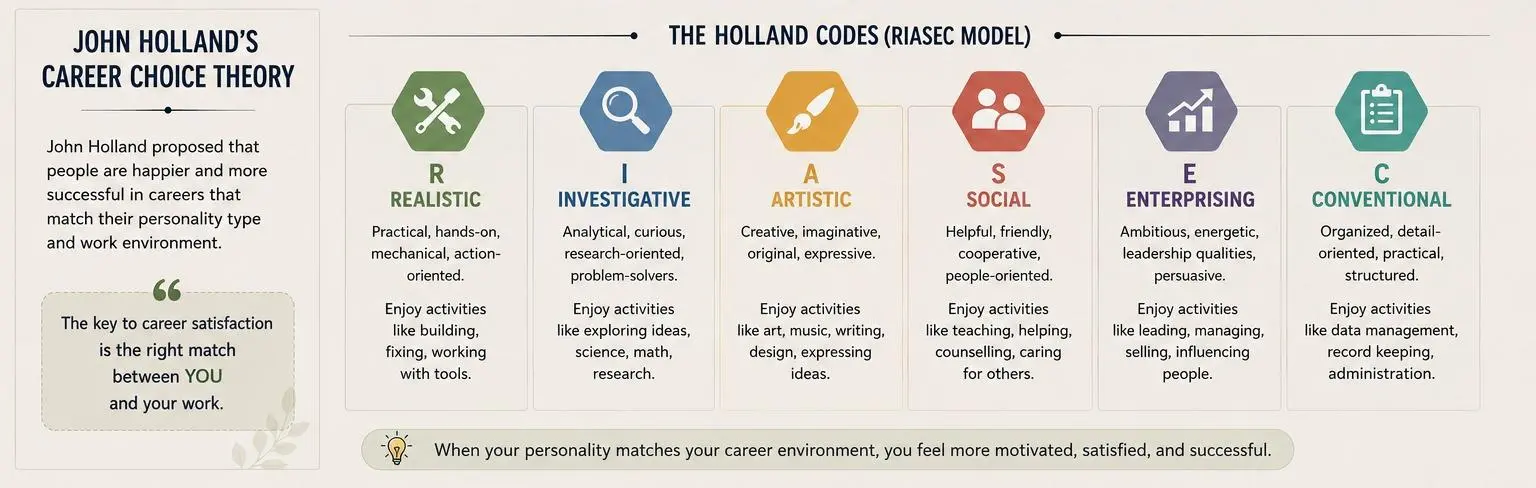
The Theory Behind Career Satisfaction
John L. Holland explained that people are naturally happier and more successful when their personality matches their work environment.
According to his theory, there are six major personality and career types:
- Realistic — practical, hands-on, action-oriented
- Investigative — analytical, curious, research-oriented
- Artistic — creative, expressive, imaginative
- Social — helping, teaching, emotionally connected
- Enterprising — leadership, business, influencing people
- Conventional — organized, structured, detail-focused
This model is often called the RIASEC model.
The theory explains something very powerful:
A student may struggle in one environment but naturally perform better in another environment that matches their personality.
The student during counselling slowly realized something important about himself. He was highly creative, expressive, emotionally aware, and interested in communication-based work. But he was trying to survive in a career path built mostly around competition, rigid structure, and constant pressure.
Slowly, he had started believing:
“I’m not capable.”
When actually, he was simply disconnected from his natural strengths.
This is why career counselling today is not only about choosing jobs. It is about understanding personality, emotional comfort, interests, and work environments.
Because forcing students into careers that do not align with who they are can slowly affect:
- confidence,
- motivation,
- emotional well-being,
- and self-worth.
One of the biggest problems in today’s education system is that students are often appreciated only for limited forms of success. A child who is artistic, emotionally intelligent, socially skilled, or creative may start feeling “less intelligent” simply because their strengths are different from traditional academic expectations.
Over time, students stop understanding themselves and start performing versions of success created by society.
And psychologically, this creates emotional exhaustion.
During proper career guidance sessions, the student slowly began understanding his own personality type, interests, communication style, and emotional needs. For the first time, he stopped asking:
“What career is respected the most?”
And started asking:
“What kind of work allows me to feel alive, confident, and connected to myself?”
That one emotional shift changed his entire approach towards life.
Today, many teenagers are not failing because they lack potential.
They are struggling because they are trying to grow in environments that do not match who they naturally are.
A creative student forced into highly rigid environments may feel emotionally drained.
A socially intelligent student may struggle in isolated work.
An analytical student may feel disconnected in careers requiring constant emotional interaction.
This does not mean the student is weak.
It simply means human beings grow differently.

Leave a Comment
To post comment, please