

Teen Life · Career Identity · Career Counselling
Somewhere around the age of twelve or thirteen, the question arrived, almost ceremonially, at every Indian dinner table of a certain kind: "So — doctor or engineer?"
Not "what do you enjoy?" Not "what are you curious about?" Not even "what are you good at?" The question presupposed its own answer space. Two doors. Pick one. The fact that a child might have wanted to design buildings, write, work with animals, teach mathematics, run a business, or do something that did not yet have a name in the family's vocabulary was never really part of the conversation.
Most people who grew up with this question did not experience it as oppression. They experienced it as simply how the world worked — the way gravity works, or the school timetable works. It did not feel like a restriction because no alternative was ever visible enough to be missed.
That invisibility is precisely the problem. And psychology has a specific name for what it produces.
"A choice between two options is not freedom. It is the appearance of freedom, designed to make a narrow path feel like the whole world."
What psychologists call identity foreclosure — and why "doctor or engineer" is a textbook case
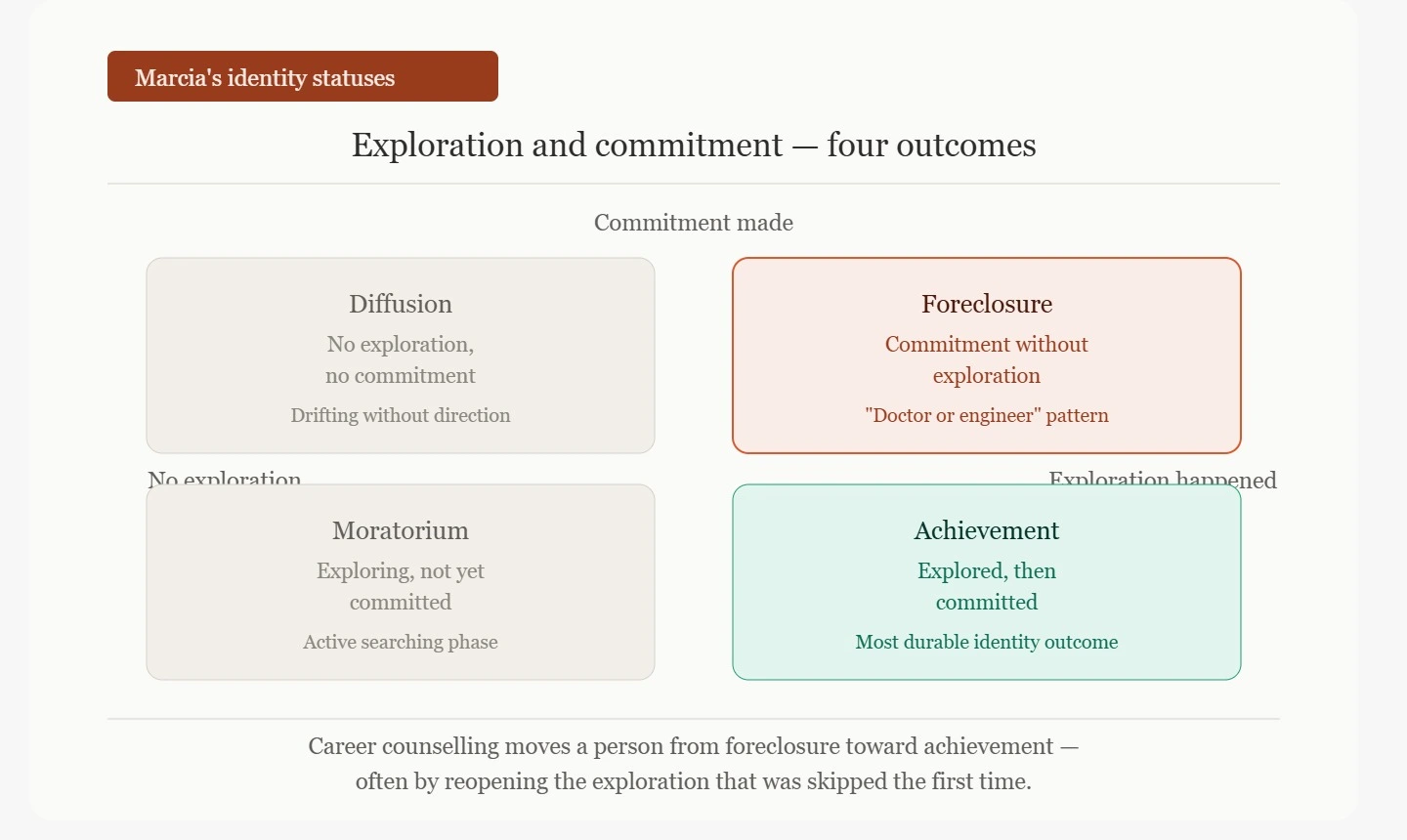
Building on Erik Erikson's work on identity development, psychologist James Marcia identified four distinct identity statuses that describe how people navigate the task of figuring out who they are. One of these statuses is called identity foreclosure — a condition in which a person commits to an identity, including a career identity, without ever genuinely exploring alternatives. The commitment is firm. The exploration that should have preceded it never happened.
Marcia's research found that foreclosed individuals often appear well-adjusted on the surface — they are decisive, conforming, and free of the visible anxiety associated with genuine identity exploration. But this apparent stability is, in Marcia's words, often fragile rather than secure. Because the identity was never tested against real alternatives, it tends to be held rigidly, defended anxiously, and — crucially — prone to sudden and disorienting collapse later in life when circumstances finally force the unexamined questions to the surface.
"Doctor or engineer" is identity foreclosure delivered as a binary choice. It gives a child the experience of choosing — which feels meaningfully different from simply being told what to do — while ensuring that the actual range of exploration never extends beyond two pre-approved, family-sanctioned, socially prestigious options. The child feels agency. The agency is real but radically constrained, like being asked to choose your favourite colour from a box containing only red and blue.
Why these two professions specifically — and what they were really standing in for
It is worth understanding why doctor and engineer became the two sanctioned options, rather than dismissing the pattern as arbitrary. For a generation of Indian parents who came of age in decades of significant economic uncertainty, these two professions represented something specific and legitimate: clearly defined training paths, internationally portable qualifications, reliable demand, and — critically — unambiguous social respect that did not require explanation at a wedding or a family gathering.
In a environment where economic stability could not be assumed, this was not irrational parenting. It was risk management, executed through the only mechanism available — narrowing the question until the answer was safe. The tragedy is not that parents wanted security for their children. The tragedy is that the mechanism for achieving it required eliminating the exploration phase that healthy identity development depends on.
What gets lost when exploration is removed
Developmental psychologists, including Marcia and those who built on his work, consistently find that identity achieved through genuine exploration — trying things, sometimes failing, comparing real alternatives, sitting with uncertainty before committing — produces more durable psychological outcomes than identity adopted through foreclosure. People with achieved identities show greater resilience under stress, more stable self-esteem, and a stronger capacity to revise their commitments when circumstances genuinely change.
Foreclosed identities, by contrast, often function well until they are tested. And the test, for many "doctor or engineer" graduates, arrives precisely in the first real professional disappointment — a difficult specialisation match, a posting they did not want, a layoff, a missed promotion. Because the identity was never built through genuine exploration, there is no internal reference point for "what else I could be." There is only the original choice, and the absence of it.
Tanvi's story — an engineer who never wanted to be one
Tanvi was a mechanical engineer working in a manufacturing firm near Pune. She had chosen engineering — or, more precisely, engineering had been chosen and she had agreed — because she scored well in mathematics and physics, and because the alternative offered at home was medicine, which she liked even less. There had never been a third option on the table. Not because Tanvi lacked other interests, but because no one had ever asked what those interests were.
By twenty-nine, Tanvi was competent, promotable, and quietly miserable in a way she found difficult to justify, since her career was, by the only metric she had ever been given, working exactly as intended. When she eventually sought career counselling, the most useful early exercise was disarmingly simple: listing every subject, hobby, or activity she had ever genuinely enjoyed, with no career filter applied at all.
The list included design, textiles, sketching, and an old, half-forgotten fascination with architecture that had surfaced briefly at sixteen and been gently redirected before it ever became a real conversation. Tanvi had not lost interest in architecture. She had simply never been permitted to explore whether it was a viable path — because the menu had only ever offered two items, and architecture was not one of them.
Career counselling did not send Tanvi back to architecture school at twenty-nine, though for some clients that kind of pivot is exactly right. For Tanvi, the more strategic move was lateral: a transition into industrial design within the manufacturing sector, using her engineering credentials as a foundation rather than a cage, while finally engaging the part of her identity that had been waiting fourteen years for someone to ask about it.
Why this pattern is harder to undo than open rebellion
One of the more counterintuitive findings in identity research is that foreclosed identities can be more difficult to revisit than identities formed through visible conflict. A young person who openly fought their parents about a career choice at least has a memory of wanting something different — a thread to pull on later. A young person who quietly absorbed "doctor or engineer" as simply how things are has no such thread. There was no fight to remember, because there was never a perceived alternative to fight for.
This is why so many adults in this situation describe their dissatisfaction as confusing rather than clear. They are not nursing a grudge about a path not taken. They genuinely do not know, until guided through structured exploration, that other paths were ever a live possibility for someone like them. The work of career counselling in these cases often begins with something more basic than choosing a new direction — it begins with demonstrating that other directions were ever real options at all.
What career counselling does to reopen a foreclosed identity
Recovering the suppressed interests. Most foreclosed individuals are not without interests — they simply stopped registering them as legitimate career signals somewhere around adolescence. A structured interest inventory, taken seriously and without judgment, often surfaces genuine patterns that the person themselves had dismissed as irrelevant hobbies.
Distinguishing aptitude from identity. Being good at mathematics does not mean engineering was your authentic choice — it means engineering was available to someone with your aptitude. Career counselling helps separate "what I am capable of" from "what I actually want," a distinction that foreclosure systematically erases.
Building a bridge, not demanding a leap. Reopening a foreclosed identity rarely means discarding fifteen years of training. It usually means finding the adjacent space where existing skills meet long-suppressed interest — exactly as Tanvi's transition into industrial design demonstrates. The goal is integration, not erasure.
Conclusion
"Doctor or engineer" was never really a question. It was a closed door dressed up as a choice, offered by parents whose love was genuine even when their method narrowed everything it touched. Understanding this does not require blaming anyone. It requires, finally, looking honestly at what was never explored — and recognising that the absence of a memory of wanting something else is not proof that nothing else was ever there.
You are allowed to ask, even now, even with a degree and a stable job and a title that satisfies everyone at family gatherings, what else might have been true about you. The exploration that was skipped at thirteen can still happen at thirty-three. It is later than the textbooks expect. It is not too late.
There were always more than two doors. Someone simply forgot to show you the rest of the building.
Ready to finally explore what was never on the menu?
Book a personalised career counselling session by Allegiance Educare.
Frequently asked questions
What is identity foreclosure in psychology?
Identity foreclosure, a concept developed by psychologist James Marcia building on Erik Erikson's work, describes committing to an identity — including career identity — without genuinely exploring alternatives first. Foreclosed individuals often appear stable and decisive, but their commitment was never tested against real options, which can make it more fragile under stress than identity formed through deliberate exploration. "Doctor or engineer" upbringing is a commonly cited real-world example of structurally induced foreclosure.
Why did Indian parents historically only offer doctor or engineer as careers?
For a generation that experienced significant economic uncertainty, medicine and engineering offered clearly defined training paths, strong and stable demand, internationally recognised qualifications, and unambiguous social respect. Parents narrowing choices to these two fields were generally engaging in a reasonable form of risk management given the information and options available to them — not acting out of indifference to their children's individuality, even though the practical effect often suppressed genuine career exploration.
I don't remember ever wanting a different career. Does that mean foreclosure didn't happen to me?
Not necessarily. One of the more counterintuitive aspects of identity foreclosure is that it often leaves no memory of wanting something different, precisely because alternatives were never made visible enough to be desired. The absence of a remembered alternative is not evidence that no alternative would have suited you — it is often evidence that the foreclosure was thorough enough to prevent the alternative from ever registering as a real option in the first place.
Can you reopen a foreclosed career identity as an adult?
Yes, and it is a common and productive focus of career counselling for adults in mid-career. The process typically begins with structured exploration — surfacing genuinely held interests that were never given career consideration — followed by an honest assessment of how those interests might integrate with existing skills and credentials. As demonstrated by cases like Tanvi's transition from mechanical engineering into industrial design, the most effective path is usually a bridge between what was foreclosed and what already exists, rather than a complete restart.
How is identity foreclosure different from simply making a practical career choice?
A practical career choice made after genuine exploration — where alternatives were considered, even briefly, and a decision was made with awareness of trade-offs — is psychologically very different from foreclosure, even if the final decision looks identical from the outside. The defining feature of foreclosure is not the choice itself but the absence of exploration preceding it. Someone can choose medicine after exploring several options and conclude it suits them best; that is identity achievement, not foreclosure. The distinction lies in process, not outcome.
How can parents avoid creating identity foreclosure in their children's career choices?
The key is preserving genuine exploration even within reasonable boundaries around practicality and security. This does not require unlimited options — most adolescents benefit from some structure — but it does require actively surfacing a wider range of possibilities than two pre-approved professions, encouraging real engagement with a young person's stated interests even when those interests seem impractical, and treating career exploration as an ongoing conversation rather than a single decision made once around age sixteen and never revisited. Career counsellors increasingly work directly with families on exactly this balance.

Leave a Comment
To post comment, please