

From Arts to MBA — Why Switching Streams Doesn't Mean Starting Over
One of the biggest fears students have when considering a new career path is the feeling that they are "starting from zero." This is especially common among Arts students who dream of pursuing an MBA or entering the business world. Many worry that because they didn't study Commerce or Management earlier, they will always be behind.
The truth is very different.
Switching from Arts to MBA does not mean starting over. It means building on the knowledge, skills, and experiences you have already gained while moving toward new opportunities.
The Myth That Your First Stream Decides Your Entire Career
Many students believe that the stream they choose in school determines their entire future. This misconception often creates unnecessary stress and limits career exploration.
In reality, today's job market values skills, adaptability, communication, leadership, and problem-solving more than a fixed educational path. Universities and employers increasingly recognize that students from different academic backgrounds bring unique perspectives.
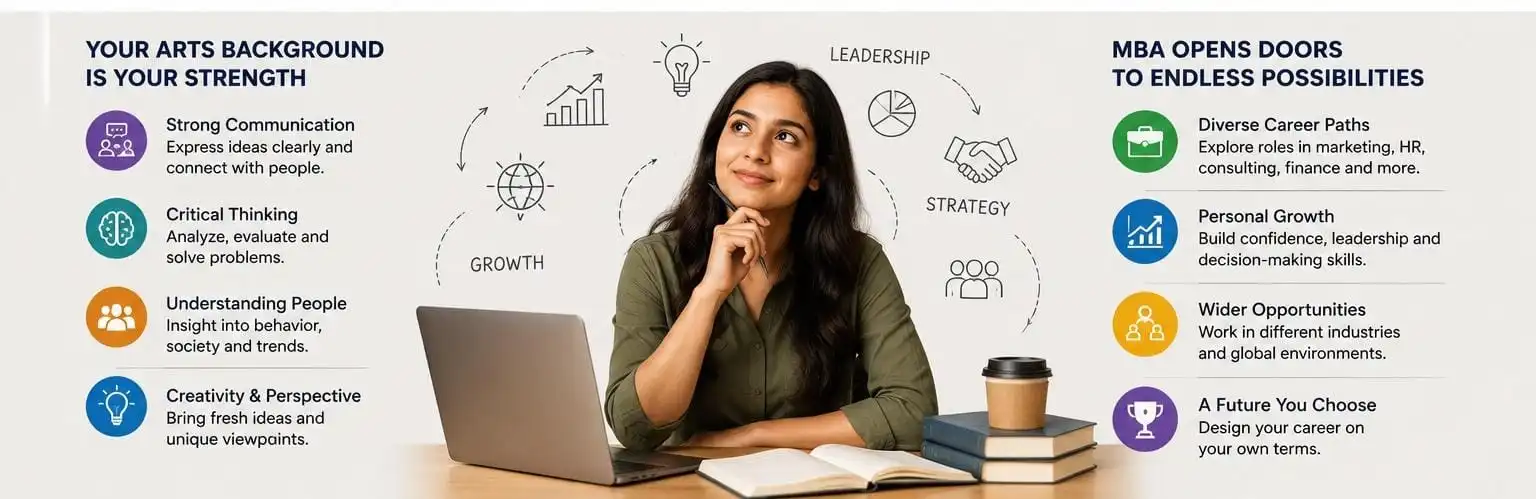
Your Arts degree is not a disadvantage—it can actually become a strength.
What Arts Students Already Bring to an MBA
Students from Arts backgrounds often develop valuable skills throughout their education that are highly useful in management roles.
Strong Communication Skills
Arts students spend a lot of time reading, writing, presenting ideas, and analyzing information. These skills are essential in marketing, human resources, consulting, and leadership positions.
Critical Thinking and Creativity
MBA programs are not only about numbers. Businesses need people who can understand human behavior, solve complex problems, and think creatively. Arts students often excel in these areas.
Understanding People and Society
Subjects such as Psychology, Sociology, Political Science, and Literature help students understand human motivations, social trends, and decision-making processes. These insights are extremely valuable in business environments.
Why MBA Programs Welcome Diverse Backgrounds
A successful business team requires different perspectives. If everyone comes from the same educational background, innovation can suffer.
This is why MBA programs actively admit students from Arts, Science, Engineering, Commerce, and many other disciplines. Diversity in the classroom leads to richer discussions, better problem-solving, and stronger leadership development.
In fact, many successful managers and entrepreneurs started their careers in completely different fields before moving into business and management.
Challenges You May Face
While the transition is possible, it is important to be realistic about the learning curve.
You may initially need to learn concepts such as:
- Finance
- Accounting
- Economics
- Business Analytics
- Marketing Fundamentals
The good news is that these subjects are taught during MBA programs, and thousands of students from non-commerce backgrounds successfully learn them every year.
Remember, lacking prior knowledge does not mean lacking potential.
How to Prepare for the Transition
Learn Basic Business Concepts
Online courses, books, and workshops can help you understand fundamental business concepts before starting your MBA journey.
Build Practical Skills
Develop skills such as communication, leadership, teamwork, and problem-solving. These are often just as important as technical knowledge.
Gain Relevant Experience
Internships, volunteering, student leadership roles, and project work can strengthen your MBA profile and improve your confidence.
Focus on Your Strengths
Instead of worrying about what you don't know, recognize the strengths your Arts background already provides. Confidence and self-awareness can make the transition much smoother.
The Role of Career Counselling
Many students hesitate to switch streams because they fear making the wrong decision. Career counselling helps students understand their interests, strengths, personality traits, and long-term goals before choosing a new academic or professional direction.
A career counsellor can help you evaluate whether an MBA aligns with your aspirations and guide you toward the right specialization and career path.
Conclusion
Your educational journey is not a straight line, and it doesn't have to be. Choosing an MBA after Arts is not about abandoning your past—it is about expanding your future.
The skills you gained through your Arts education remain valuable. They become the foundation on which you build new business knowledge, leadership abilities, and career opportunities.
Remember: changing direction is not starting over. It is growing.
Confused about your next step after Arts? Wondering whether an MBA is the right choice for you?
Book your personalized career counselling session today with Allegiance Educare and take the next step toward a successful future with confidence.

Leave a Comment
To post comment, please