


“I Don’t Want to Prepare for JEE Anymore”
A 17-year-old student sat quietly during counseling and said:
“Earlier I used to study for JEE seriously… but now suddenly I don’t feel interested anymore.”
His parents were worried.
“You are becoming distracted.”
“You are wasting your potential.”
“You were doing so well before.”
But the deeper question was:
Was the student truly losing discipline?
Or was something psychological happening inside him?
Today, many students preparing for competitive exams suddenly feel emotionally disconnected from the process. They start avoiding studies, losing motivation, overthinking constantly, or feeling mentally exhausted.
And often, this is not simply about “lack of focus.”
Sometimes it is about identity, emotional pressure, and intelligence mismatch.
The Emotional Side of JEE Preparation
In India, students preparing for JEE often carry invisible emotional pressure.
They are not only preparing for an exam.
They are carrying:
- expectations,
- fear of failure,
- comparison,
- uncertainty,
- and pressure to prove their worth.
According to Rational Emotive Behavior Therapy (REBT), emotional distress is not created only by situations — but by beliefs attached to those situations.
The student slowly develops thoughts like:
- “If I leave JEE, I’m a failure.”
- “I must succeed to make everyone proud.”
- “If I choose another path, my future is ruined.”
- “Everyone else is moving ahead except me.”
These beliefs create emotional exhaustion.
And after continuous pressure, the brain sometimes emotionally disconnects from the goal itself.
This is why many students suddenly say:
“I don’t feel interested anymore.”
What If the Problem Is Not Capability — But Intelligence Type?
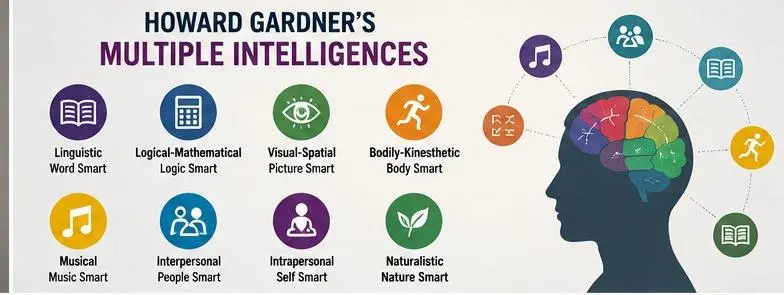
This is where Theory of Multiple Intelligences by Howard Gardner becomes very important.
Traditional education systems often measure intelligence mainly through:
- marks,
- logic,
- physics,
- mathematics,
- and memorization.
But Howard Gardner explained that intelligence is much broader than academics alone.
According to his theory, students can have different types of intelligence such as:
- Logical Intelligence
- Linguistic Intelligence
- Musical Intelligence
- Interpersonal Intelligence
- Intrapersonal Intelligence
- Visual-Spatial Intelligence
- Bodily-Kinesthetic Intelligence
- Naturalistic Intelligence
This means:
A child struggling with JEE preparation may still be highly intelligent — just in a different way.
The Student’s Hidden Strength
During counseling and multiple intelligence assessment, it was discovered that the student was highly:
- creative,
- emotionally aware,
- visually imaginative,
- and strong in communication.
But his entire environment was rewarding only one form of intelligence:
academic competition.
Slowly, he started feeling disconnected from himself.
He was studying constantly, but emotionally he could not relate to the path anymore.
This is something many students experience silently.
Sometimes students do not lose intelligence.
They lose emotional connection with a career path that does not match their natural strengths.
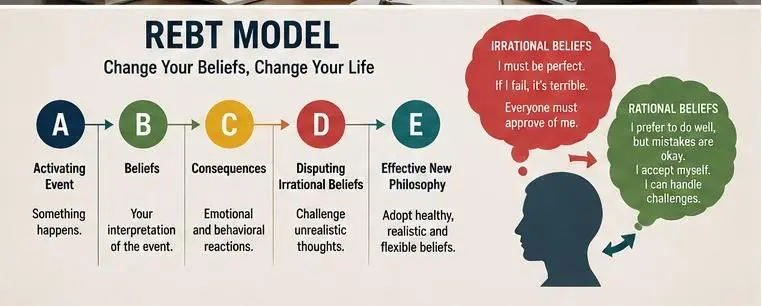
REBT Helps Students Understand Their Thoughts
Instead of labeling the student as “lazy,” REBT helps explore the beliefs behind the emotional burnout.
Irrational Belief:
“If I don’t clear JEE, I can never become successful.”
Healthier Belief:
“JEE is one career path, not the only path.”
Irrational Belief:
“I must continue even if I’m mentally exhausted.”
Healthier Belief:
“It is okay to re-evaluate my goals and understand myself better.”
This shift reduces guilt, fear, and emotional pressure.
Why Multiple Intelligence Testing Matters
Many students are preparing for careers based on:
- social expectations,
- parental pressure,
- comparison,
- or fear of instability.
But career satisfaction often comes when a student’s natural intelligence aligns with their work.
Multiple Intelligence Testing helps students understand:
- how they learn,
- where their strengths lie,
- what environments suit them,
- and what kind of work feels meaningful naturally.
This creates better self-awareness instead of forced career decisions.
Students Today Need Understanding, Not Only Pressure
Not every student leaving JEE preparation is weak.
Some are emotionally exhausted.
Some are psychologically overwhelmed.
Some are simply discovering that their intelligence and personality belong somewhere else.
And understanding this difference is very important.
Because forcing a student to continue a path without emotional connection can slowly damage:
- confidence,
- self-worth,
- motivation,
- and mental well-being.
FAQs
What is Howard Gardner’s Multiple Intelligence Theory?
It is a psychological theory suggesting that intelligence is not limited to academics alone. People can have different types of intelligence like creative, interpersonal, musical, logical, and visual intelligence.
What is REBT in psychology?
REBT (Rational Emotive Behavior Therapy) is a psychological approach developed by Albert Ellis that focuses on changing irrational beliefs affecting emotions and behavior.
Why do students suddenly lose interest in JEE preparation?
Students may experience emotional burnout, pressure, fear of failure, lack of personal interest, or a mismatch between their natural abilities and the career path.
Can intelligence exist outside academics?
Yes. According to Theory of Multiple Intelligences, intelligence can appear in creativity, communication, leadership, music, art, self-awareness, and many other forms.
How does REBT help students emotionally?
REBT helps students challenge unhealthy thoughts like “failure defines my life” and replace them with healthier, realistic thinking patterns.
What is Multiple Intelligence Testing?
It is an assessment process that helps identify a student’s dominant strengths, learning style, and natural intelligence areas.

Leave a Comment
To post comment, please