

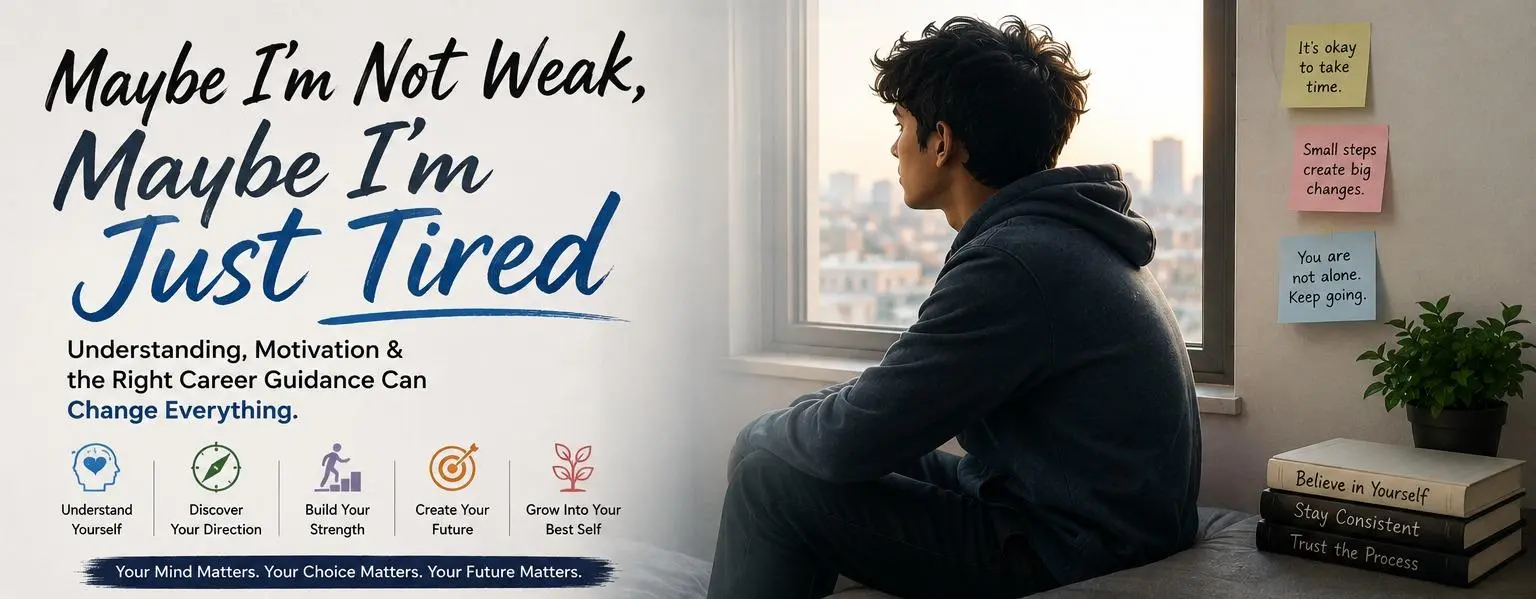
“Maybe I’m Not Weak, Maybe I’m Just Tired”
A 19-year-old boy once came for career counselling, but strangely, he spoke very little about careers. Most of the conversation was about exhaustion. Not physical exhaustion — emotional exhaustion. He looked like a normal student from outside. He attended classes regularly, tried to study, stayed quiet at home, and did not create problems for anyone. But internally, he felt completely disconnected from himself.
When asked what was troubling him the most, he simply said, “Earlier I used to dream about my future. Now I just feel tired all the time.”
His parents believed he had become distracted because of his phone. Teachers felt he was losing focus. Relatives kept saying that students today do not know how to handle pressure. But nobody truly understood what was happening inside his mind. The truth was that he had been carrying pressure silently for years.
Since childhood, he was always known as the “good child.” He performed well in school, listened to everyone, avoided arguments, and always tried to make people proud. Slowly, without realizing it, he started connecting his self-worth with achievements. Appreciation came when he scored well. Attention came when he succeeded. Love felt stronger when he performed better. And this is where many teenagers silently begin losing themselves.
In 11th standard, he started preparing seriously for competitive exams. Initially, he was motivated. Like many students, he made study timetables, watched motivational videos, bought books, and imagined a successful future. But after some time, studying stopped feeling like learning. It started feeling like survival. Every test score began deciding his confidence. Every comparison with friends created anxiety. Every discussion about careers made him overthink his future even more.
At night, he would sit in front of his books for hours, but his mind was somewhere else. He constantly thought, “What if I disappoint everyone?” “What if I fail?” “What if everyone moves ahead in life and I stay behind?” Slowly, overthinking became his normal state. He was mentally present everywhere, but emotionally absent from his own life.
One day he finally told his parents, “I don’t feel interested anymore.” But instead of trying to understand his emotional state, people immediately focused on fixing his productivity. They told him to become more disciplined, study harder, and stop overthinking. Their intentions were not wrong, but emotionally, it made him feel even more alone. Because the problem was no longer only about studies. The problem was that he no longer felt connected to himself.
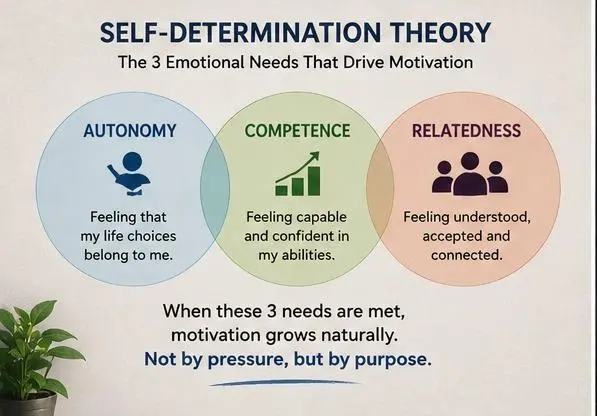
The Psychological Theory Behind His Feelings
This situation can be understood deeply through Self-Determination Theory, which explains that human beings need three emotional needs to feel mentally healthy and motivated:
- Autonomy — feeling that life choices also belong to you
- Competence — feeling capable and confident in your abilities
- Relatedness — feeling emotionally understood and connected
Slowly, this student had lost all three. His life decisions no longer felt like his own, repeated comparison made him doubt his abilities, and he felt emotionally valued only when he achieved something. When these emotional needs remain ignored for too long, motivation naturally starts disappearing. Not because the person is lazy, but because emotionally they feel disconnected from their own identity.
What made the biggest difference during counselling was surprisingly very simple. For the first time, someone stopped asking him, “How many hours are you studying?” and instead asked him, “What do you actually feel?” That one question broke years of emotional silence. He was not weak. He was not incapable. He was simply tired of carrying invisible pressure alone.
Slowly, through emotional support and career guidance, he started understanding himself beyond marks and performance. He began separating self-worth from achievements. He started exploring his interests without guilt and learning that career growth is not always a straight line. Most importantly, he realized that one exam, one failure, or one delay does not define an entire life.
Today, many teenagers silently live this exact story. From outside they may look distracted, lazy, or unmotivated, but internally they are carrying fear, uncertainty, comparison, and emotional exhaustion every single day. Most teenagers are not asking for perfection. They are asking to feel understood.
Sometimes students do not need more pressure. Sometimes they simply need someone who reminds them that they are human before they are performers.
FAQs
What is Self-Determination Theory in psychology?
Self-Determination Theory explains that people need autonomy, competence, and emotional connection to stay motivated and mentally healthy.
Why do teenagers suddenly lose motivation?
Teenagers may feel emotionally exhausted due to pressure, comparison, fear about the future, and lack of emotional support.
Is every unmotivated student lazy?
No. Many students are emotionally overwhelmed or mentally tired rather than lazy.
How does emotional pressure affect students?
Continuous emotional pressure can reduce confidence, focus, motivation, and emotional well-being.
Why is emotional understanding important in career counselling?
Students make healthier career decisions when they feel emotionally safe, understood, and involved in the decision-making process.
What are common emotional struggles among teenagers today?
Many teenagers struggle with:
- anxiety,
- overthinking,
- comparison,
- fear of failure,
- career confusion,
- and emotional burnout.

Leave a Comment
To post comment, please