

She Had the Salary. The Title. The Life Everyone Wanted. Then One Morning She Could Not Get Out of Bed.
Real Life Cases · Career Burnout · Career Counselling
Preethi earned more money at thirty-two than anyone in her family had ever earned at any age. She knew this because her mother mentioned it regularly, with a particular mixture of pride and disbelief that Preethi had learned to recognise as the closest thing to love her mother knew how to express in practical terms. The salary was real. The apartment it paid for was real. The title on her email signature — Senior Vice President, Strategy — was real.
The morning she could not get out of bed was also real.
Not metaphorically. Not as a figure of speech for feeling unmotivated. She lay in a flat that costs more per month than her father earned in a year, stared at the ceiling, and genuinely could not locate within herself a reason sufficient to move. The laptop on the desk represented a day of things she was entirely capable of doing and no longer capable of caring about. The phone showed fourteen messages from colleagues who needed things from her. She left them unread and went back to sleep.
This is not a story about ingratitude. It is a story about what burnout actually looks like when it arrives in a high-performing, highly compensated professional at the peak of a career that was, by every available metric, working.
"Burnout does not arrive because you have too little. It arrives when you have built the wrong thing for long enough that your system finally refuses to pretend otherwise."
What burnout is — and why salary is the last thing that prevents it
Burnout, as defined by the World Health Organisation in its International Classification of Diseases, is a syndrome resulting from chronic workplace stress that has not been successfully managed. It is characterised by three specific dimensions: feelings of energy depletion or exhaustion, increased mental distance from one's job, and reduced professional efficacy. The WHO's recognition of burnout as an occupational phenomenon — not a personal failing — was a significant shift in how the condition is understood, both medically and culturally.
What the clinical definition captures and what public conversation about burnout frequently misses is this: burnout is not caused by working too hard in absolute terms. It is caused by working hard in a sustained state of misalignment — a prolonged disconnect between what the work demands and what the person doing it genuinely values, needs, or can psychologically sustain. Salary addresses the question of whether the work is adequately compensated. It says nothing about whether the work is adequate for the person doing it.
This distinction is precisely why burnout is so counterintuitive in high earners. From the outside, a high salary looks like a strong reason to continue. From the inside of a burned-out professional, the salary is often the only thing that has kept them going for years past the point their internal system first registered a serious objection — which is, ironically, why the burnout that eventually arrives in high earners tends to be more severe than in people who left earlier, before the compensation made leaving feel financially reckless.
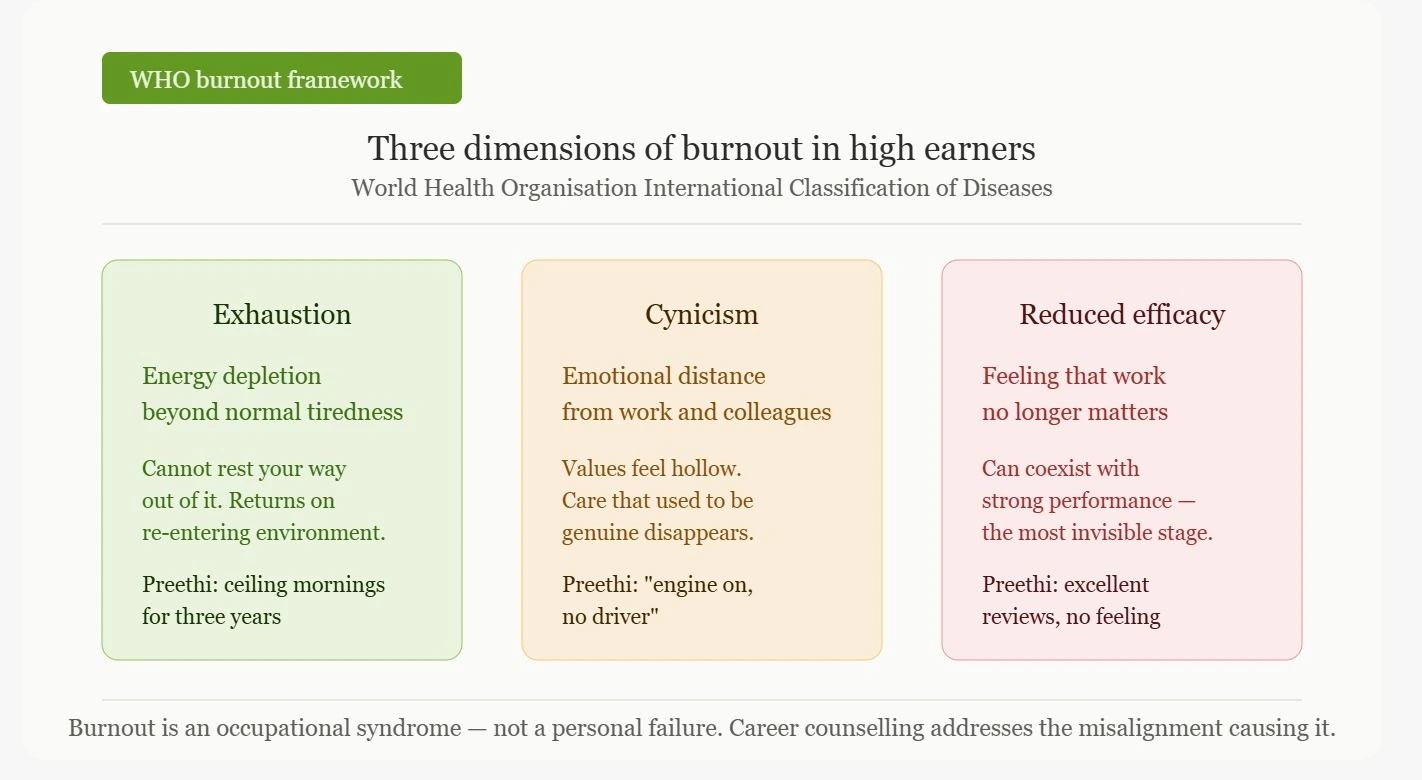
The three years before the morning she could not move
Preethi's burnout did not arrive suddenly. It arrived the way most serious burnout arrives — incrementally, deniably, and across a period long enough that each individual symptom could be attributed to something else.
Year one after her promotion: consistently poor sleep, which she attributed to the new role's demands and treated as temporary. Reduced appetite for social engagement, which she attributed to a busy schedule. A slight but persistent flatness to her emotional experience of work, which she attributed to the natural settling of initial excitement after a promotion.
Year two: increasing reliance on the weekend to simply function. A growing inability to be present during the working day without significant effort. A creeping cynicism about colleagues, clients, and the company's stated values that she recognised as unlike her but could not seem to locate or address. Performance remained excellent throughout — she was, professionally, doing better than ever. Internally, she described it later as "having the engine on but no driver."
Year three: the ceiling morning. Followed by a week of similar mornings. Followed by a conversation with her manager in which she requested a leave of absence, citing personal reasons, and spent the first three days of that leave watching television without retaining a single thing she watched.
She came to career counselling in the fourth week of her leave, not because she had a plan but because she had exhausted the alternatives — rest, which helped temporarily and then stopped; conversations with friends, who told her she was lucky and perhaps overthinking; and a quiet, private certainty that something more fundamental than fatigue had broken down.
Why high-earning professionals stay too long — the specific trap of financial success
There is a particular and cruel irony at the centre of burnout in well-compensated professionals. The same success that produces the burnout also produces the most powerful reasons to stay — lifestyle commitments sized to the salary, family expectations anchored to it, professional identity built so entirely around the role that leaving feels like a kind of self-erasure.
Psychologists sometimes describe this as the "golden handcuff" effect — a situation in which financial reward becomes, over time, not a reflection of the job's worth to the person but an active mechanism trapping them within it. The compensation that was initially motivating becomes, paradoxically, the primary obstacle to the change that would address the misalignment producing the burnout.
In India specifically, this trap has an additional layer: the salary is rarely only personal. For a first-generation high earner like Preethi, the income carries the weight of family security, of parents' retirement plans, of younger siblings' educations, of the entire family's social standing. Leaving a six-figure salary is not experienced as a personal career decision. It is experienced as a betrayal of everyone the salary was also quietly serving. The burnout continues not just because leaving is financially difficult but because leaving feels morally impossible.
What the career counselling process actually looked like
The first thing career counselling did for Preethi was not produce a new career. It produced a diagnosis — a precise account of what had been happening and why, which was itself more useful than anything her previous weeks of rest had delivered, because it gave the experience a framework rather than leaving it as an unstructured collapse.
The counselling process identified three converging factors that together produced the burnout. First: a fundamental values mismatch between Preethi's genuine orientation — she was, at her core, interested in people, in education, in working on problems that had a direct human impact — and the strategy consulting work she had spent nine years doing, which was intellectually demanding, financially rewarding, and almost entirely abstracted from any visible human outcome.
Second: an identity that had become so fused with professional performance that there was no self left over when the performance became untenable. Preethi did not know who she was outside her title. Removing the title felt like removing her.
Third: a decade of financial commitments made on the assumption of a continuing income at the same level — which was not impossible to address, but required facing honestly rather than pretending did not exist.
Over four months, career counselling worked through all three. Values clarification. Identity reconstruction. Financial planning — not as a financial advisor, but as a practical acknowledgment of real constraints that shaped what transitions were genuinely possible. Preethi did not, ultimately, leave her field entirely. She transitioned into learning and development within a large education technology firm, taking a salary reduction she had planned for over six months and had stopped being afraid of by the time it arrived. She described the day she started her new role as the first morning in three years that she had woken up before her alarm.
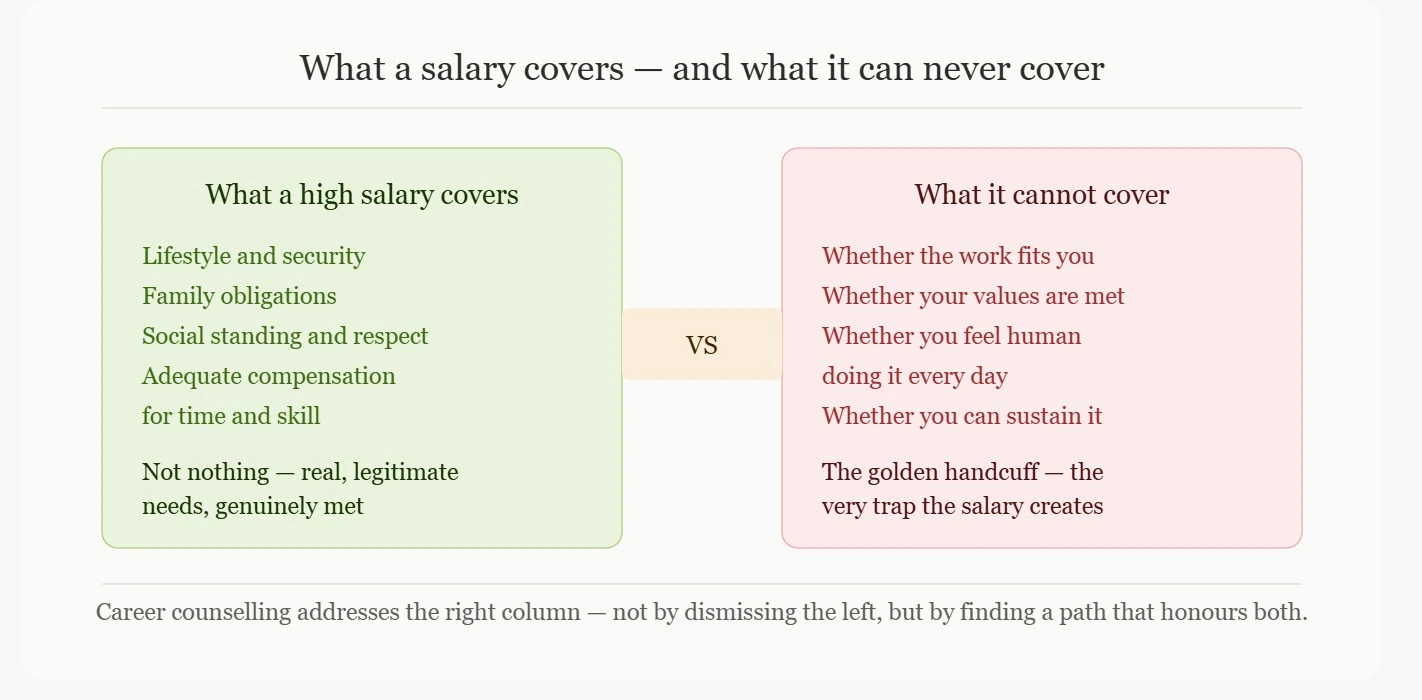
What burnout is actually telling you — and why the message is worth hearing
It is not telling you that you are weak. Burnout is significantly more common among high performers than among those with lower standards and lower output. It does not arrive in people who have given up. It arrives in people who have been giving everything for long enough that the system cannot continue.
It is not telling you that rest will fix it. Rest addresses the exhaustion component of burnout — and rest is genuinely necessary. But rest without addressing the underlying misalignment that produced the burnout is the professional equivalent of treating a fever with ice and returning to the infected environment the moment the temperature drops. The burnout returns.
It is telling you something specific about the mismatch between your work and who you are. That message is worth taking seriously — not because leaving is always the answer, but because continuing to suppress it produces costs that grow with every year the signal is ignored.
Conclusion
Preethi did not leave a six-figure salary because she was reckless, ungrateful, or confused about the value of financial security. She left because she had finally done the work — with support, with honesty, and with a plan — to understand what the alternative cost. Not the cost in rupees, but the cost in the person she was disappearing into a role that had never genuinely been built for who she was.
The morning she could get out of bed again was not the morning she quit. It was the morning she understood precisely why she needed to — and what she was moving toward, not just what she was moving away from. That distinction is everything. And it is exactly what career counselling exists to produce.
A salary can be rebuilt. The years spent disappearing inside a career that was slowly erasing you cannot be recovered. One of those facts is more worth protecting than the other.
If the salary is the only thing still holding you there, it is time to talk.
Book a personalised career counselling session Allegiance Educare.
Frequently asked questions
Can you experience burnout even with a high salary?
Yes — and high earners are, in many respects, particularly vulnerable to severe burnout precisely because financial success creates powerful incentives to stay in misaligned roles long past the point the system first registered an objection. The World Health Organisation classifies burnout as an occupational syndrome caused by chronic, unmanaged workplace stress — not by inadequate compensation. Salary addresses whether the work pays enough. It does not address whether the work is right for the person doing it.
What are the real signs of career burnout — beyond just feeling tired?
The WHO identifies three specific dimensions of burnout: energy depletion or exhaustion, increased psychological distance or cynicism toward the job, and reduced sense of professional efficacy — the feeling that what you do no longer matters or works. Importantly, burnout can coexist with strong external performance, which is part of why it so frequently goes unrecognised in high-performing professionals until it becomes a crisis.
Will rest and a vacation fix burnout?
Rest addresses the exhaustion component of burnout and is a necessary part of recovery — but it is not sufficient. Research on burnout recovery consistently finds that returning to the same misaligned environment after rest typically produces a recurrence of symptoms within weeks to months. Durable recovery from burnout requires addressing the underlying source of the misalignment — not just the exhaustion it has produced. This is precisely the work career counselling is equipped to support.
I earn well but feel empty. Is that a career problem or a mental health problem?
It can be both, and the two often coexist. Persistent emptiness despite external success can reflect career misalignment, values conflict, burnout — all occupational in nature — or it can reflect clinical depression or other mental health conditions. It is worth exploring both with the appropriate professionals. A career counsellor addresses the occupational dimension; a psychologist or psychiatrist addresses the clinical dimension. If symptoms include persistent low mood, loss of interest, or difficulty functioning, clinical evaluation should happen in parallel with career work, not sequentially.
Does leaving a high-paying job always mean a big financial sacrifice?
Not always, and rarely as much as the initial fear suggests. Career counselling for burnout-affected professionals often finds that the transition involves lateral movement rather than a complete income reset — a different role in a different kind of organisation or sector, often using the same core skills, at a salary lower than the peak but sustainable and meaningful. The financial planning component of career counselling, which takes seriously the real constraints of lifestyle and family obligation, produces transitions that are far more considered and manageable than the dramatic resignation the crisis can initially seem to demand.
How do I know if it's burnout or just a bad patch at work?
The clearest distinguishing factor is duration and pervasiveness. A bad patch has identifiable causes, is time-limited, and resolves when the specific stressor resolves. Burnout is chronic, diffuse, and persistent across changing projects, managers, and circumstances — it follows the person rather than the situation. If you have had several good jobs with good conditions and the flatness, exhaustion, or cynicism has followed you across all of them, that pattern is more consistent with burnout than with a situational difficulty that will naturally pass.

Leave a Comment
To post comment, please