

The 60-Year-Old Theory That Explains Why Your Job Feels Wrong — Even Though You're Good at It
Career Psychology · Holland's RIASEC · Career Counselling
Here is a strange but common situation. A person is competent at their job. Reviews are good. Targets are met. Colleagues consider them reliable. And yet — every single day — something feels slightly off. Not dramatically wrong. Not a crisis. Just a low, persistent sense of friction, as though they are using the wrong tool for a task they technically know how to complete.
In 1959, an American psychologist named John Holland began developing a theory that explains this feeling with remarkable precision. More than six decades later, his framework — now known as RIASEC, or the Holland Codes — remains one of the most widely used and empirically validated tools in career counselling worldwide. And it explains, better than almost anything else, why competence and fit are two completely different things.
"You can be good at something and still be wrong for it. Skill tells you what you can do. Fit tells you what you should do."
What is RIASEC — and why has it survived sixty years of psychology trends?
John Holland's central insight was simple but powerful: both people and work environments can be described using the same six categories of personality type. When a person's type closely matches the type of their work environment, the result is satisfaction, persistence, and performance. When it doesn't, the result is exactly the friction described above — competence without comfort.
The six types — Realistic, Investigative, Artistic, Social, Enterprising, and Conventional — give RIASEC its name. Most people are not purely one type. They are a combination, usually expressed as a three-letter code representing their dominant types in order. But understanding each type individually is where the clarity begins.
Realistic (R) — Practical, hands-on, prefers working with tools, machines, or the physical world. Drawn to tangible results over abstract discussion.
Investigative (I) — Analytical, curious, enjoys solving problems through research, data, and logic. Comfortable with ambiguity if it leads to understanding.
Artistic (A) — Creative, expressive, values originality and the freedom to work without rigid structure. Drawn to ideas, aesthetics, and self-expression.
Social (S) — People-oriented, empathetic, motivated by helping, teaching, or developing others. Energised by interpersonal connection.
Enterprising (E) — Persuasive, ambitious, drawn to leadership, influence, and achieving measurable outcomes through other people.
Conventional (C) — Organised, detail-oriented, comfortable with structure, systems, and clearly defined processes.
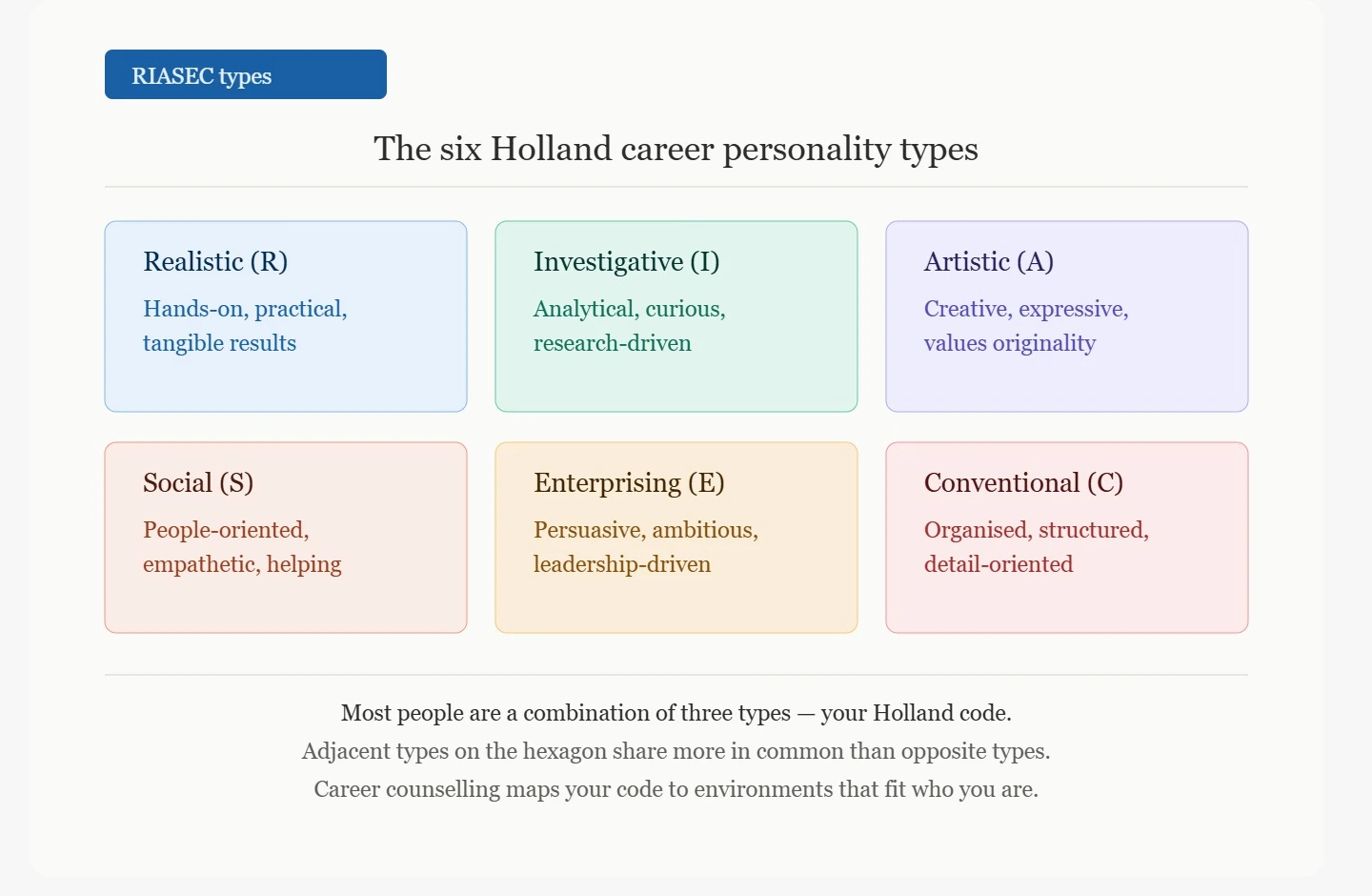
Holland arranged these six types into a hexagon — not arbitrarily, but because adjacent types share more in common than opposite types. Realistic and Investigative sit close together; Realistic and Social sit furthest apart. This geometry is not decorative. It is precisely what allows RIASEC to predict, with surprising accuracy, which careers will feel coherent to a person and which will produce the chronic, low-grade friction described at the start of this article.
Why this matters more than aptitude
Most career guidance — particularly in India — focuses almost entirely on aptitude. Are you good at mathematics? Then engineering. Are you good with words? Then law or journalism. This approach is not wrong, exactly. But it answers only one part of a two-part question. Aptitude tells you what you are capable of. It says nothing about whether doing that thing, every day, in a particular kind of environment, will sustain you.
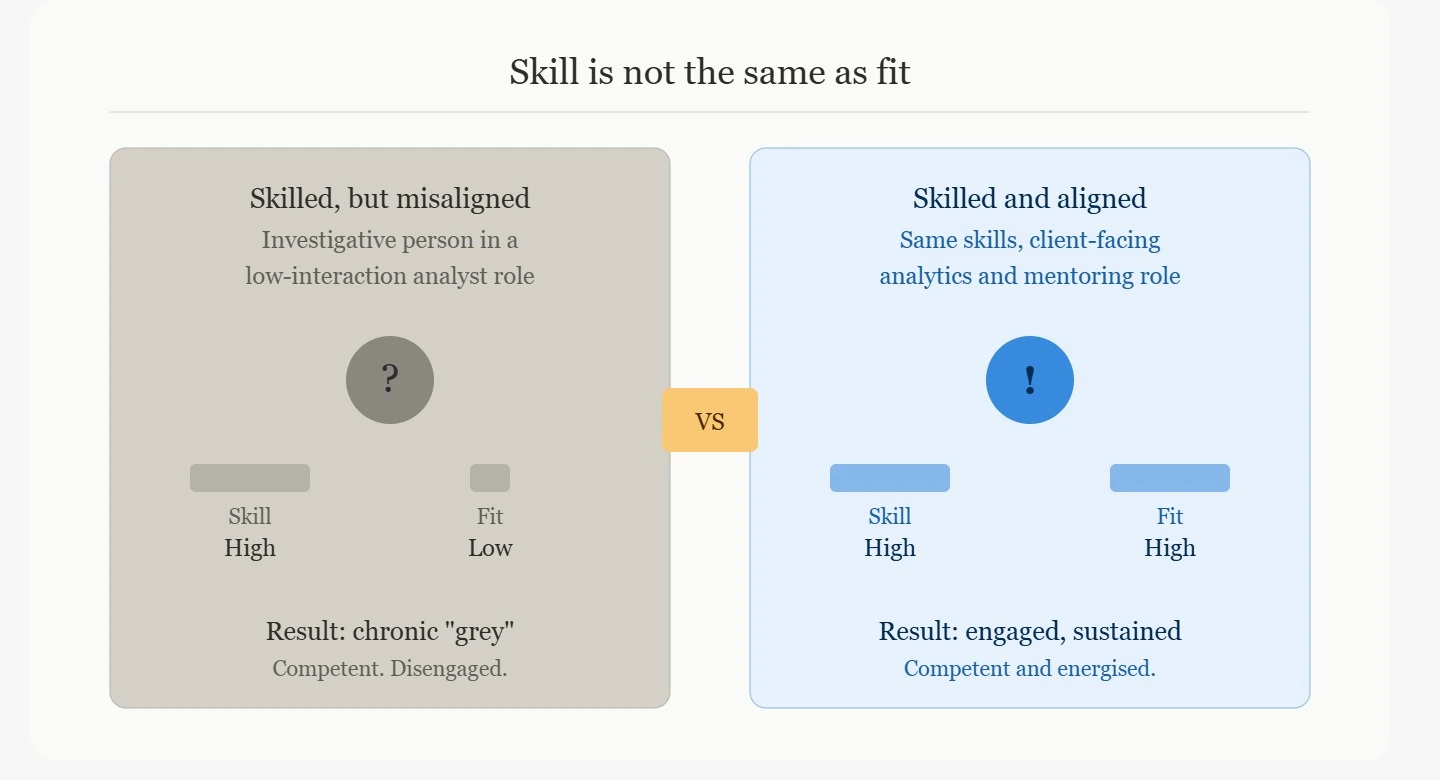
RIASEC addresses the second part. A person can have strong Investigative aptitude — excellent analytical ability — but if their dominant personality type is Social, a purely analytical role with minimal human interaction may produce exactly the kind of friction described earlier, regardless of how well they perform the analytical tasks themselves.
This is the distinction career counsellors are trained to look for — not "can this person do this job" but "will this environment feel coherent to who this person is, day after day, for years." The first question is about capability. The second is about sustainability. Both matter. Only one of them is usually asked.
Sanjana's story — high aptitude, wrong environment
Sanjana was a data analyst at a financial services company in Hyderabad. Her aptitude scores had always been excellent — strong in mathematics, logical reasoning, and pattern recognition. Her work was, by any technical measure, very good. Her dashboards were accurate. Her models performed well. Her manager had no complaints.
And yet Sanjana described her workdays as "grey" — a word she used repeatedly without quite being able to explain it further. She did not dislike the work. She simply did not feel anything about it, one way or the other. Day after day, grey.
When Sanjana completed a RIASEC-based assessment as part of career counselling, her profile came back as Social-Investigative-Artistic. Her Investigative score explained her aptitude — she was, genuinely, very good at analytical work. But her dominant type was Social. And her current role involved almost no human interaction: she worked independently, communicated primarily through written reports, and rarely engaged directly with the people whose decisions her analysis informed.
The intervention was not dramatic. Sanjana did not need a new career. She needed a different relationship to the same skill set. Within six months, she had moved into a role doing essentially the same analytical work — but as part of a client-facing analytics team, presenting findings directly to stakeholders, training junior analysts, and translating data into recommendations through conversation rather than reports alone.
The grey lifted almost immediately. Same skills. Same intelligence. Completely different experience — because the environment finally matched the person doing the work.
Why RIASEC has remained relevant for sixty years
Psychological theories come and go. Many frameworks popular in the mid-twentieth century have been quietly retired as research evolved. RIASEC has not just survived — it has been validated, refined, and incorporated into career assessment tools used by governments, universities, and counselling practices across the world, including India's own National Career Service framework, which draws on RIASEC-style interest profiling.
The reason for its durability is simple: it makes a falsifiable, testable claim — that person-environment fit predicts satisfaction and persistence — and that claim has held up across decades of research, across cultures, and across an enormous diversity of occupations. Few psychological frameworks from 1959 can make that claim. RIASEC can.
What RIASEC gets misunderstood about — and how career counselling corrects it
Misunderstanding one: "It's just a personality test." RIASEC is sometimes dismissed alongside less rigorous online quizzes. But unlike many popular personality frameworks, RIASEC was specifically designed and validated for occupational fit — not general personality description. The distinction matters. A career counsellor uses RIASEC not to tell you who you are in the abstract, but to map your type against the actual structure of work environments.
Misunderstanding two: "My code determines my career." A Holland code does not specify a job title. An Investigative-Artistic-Social profile does not mean "become a researcher who also paints and teaches." It means that environments combining analytical depth, creative latitude, and human interaction are likely to feel coherent — which could describe dozens of different roles across many industries. A career counsellor's role is translating the code into a realistic landscape of options, not a single prescription.
Misunderstanding three: "If I don't fit my current job's type, I have to quit." Often, the more useful application of RIASEC is not choosing a new career but reshaping an existing one — as Sanjana's story shows. Most roles have more flexibility in their day-to-day composition than people assume. A career counsellor's task is frequently to identify which 20% of a role can shift to dramatically improve fit, rather than discarding the 80% that already works.
Conclusion
For sixty years, John Holland's framework has quietly outlasted trend after trend in psychology — not because it is flashy, but because it asks a question most career advice forgets to ask. Not "what can you do?" but "where does who you are actually fit?"
If your work feels grey despite your competence, RIASEC may be the framework that finally explains why — and, more importantly, what to do about it. Not by abandoning what you are good at, but by finding the environment where being good at it also feels like being yourself.
Sixty years is a long time for an idea to remain true. That alone should tell you something.
Ready to find out what actually fits you?
Book a personalised career counselling session with Allegiance Educare.
Frequently asked questions
What is RIASEC and who created it?
RIASEC, also known as the Holland Codes, is a career theory developed by American psychologist John Holland beginning in 1959. It proposes that both people and work environments can be categorised into six types — Realistic, Investigative, Artistic, Social, Enterprising, and Conventional — and that career satisfaction is strongly predicted by how closely a person's type matches their work environment's type. It remains one of the most widely used and researched frameworks in career assessment today.
How accurate is RIASEC at predicting career satisfaction?
RIASEC is one of the most empirically validated frameworks in vocational psychology, with decades of research across multiple countries and occupational categories supporting the core claim that person-environment fit predicts job satisfaction, performance, and persistence. It is not a perfect predictor — no psychological framework is — but its track record of replication across a very long period of time is unusual and is part of why it remains in active use in professional career counselling and government employment services worldwide.
Can I be more than one RIASEC type?
Almost everyone is. Very few people are purely one type. RIASEC profiles are usually expressed as a three-letter code representing a person's top three types in order of strength — for example, Investigative-Artistic-Social. The combination matters as much as the individual letters, because it describes the blend of motivations a work environment needs to satisfy for that person, not a single dimension.
I am good at my job but feel unsatisfied. Could RIASEC explain that?
Very possibly. This is one of the most common patterns RIASEC explains — competence without satisfaction. Aptitude and personality fit are different dimensions. A person can be highly capable in a role that nonetheless does not match their dominant RIASEC type, producing a chronic, low-grade sense that something is "off" even though performance is genuinely good. A career counsellor can use RIASEC profiling to identify specifically what kind of environment would resolve that mismatch — sometimes through a new role, often through reshaping an existing one.
Where can I take a RIASEC assessment?
RIASEC-based assessments are used by professional career counsellors, university career centres, and some government employment services, often as part of a broader counselling process rather than a standalone test. While simplified versions exist online, a counsellor-administered assessment is generally more useful because the results are interpreted in context — alongside your specific work history, constraints, and goals — rather than producing a generic output disconnected from your actual situation.
Does RIASEC mean I have to change careers if there's a mismatch?
Not necessarily, and often not at all. Most roles contain more variety than their job title suggests — the proportion of analytical work, people interaction, creative latitude, and structured process within a role can often be reshaped without changing employers or even job titles. Career counselling frequently focuses on identifying which specific elements of a current role could shift to improve fit, which is often a faster, lower-risk path to satisfaction than a full career change.

Leave a Comment
To post comment, please