

The Career Was Never Really Yours. And Somewhere Inside, You Have Always Known It.
Parental Pressure · Career Identity · Career Counselling India
The conversation happened when you were sixteen. Or seventeen. You were sitting at the dining table, or in the car, or at some relative's house during a festival. And someone — your father, your mother, an uncle whose opinion carried weight — said it. Not unkindly. Not cruelly. With love, even. With the best intentions that love can carry.
"You will do engineering. After that, an MBA or a government exam. That is the path."
And you said yes. Or you said nothing. Or you made a small sound of disagreement that evaporated the moment you saw the expression on your parent's face — that mixture of love, sacrifice, and absolute certainty that they were steering you toward safety, toward respect, toward a life better than their own.
You are now twenty-eight. Or thirty-three. Or forty-one. And you are living the career that was decided at that table. And some days you manage it fine. And other days you sit at your desk and feel a very specific kind of hollowness — the kind that comes not from failure, but from the suspicion that you have been living someone else's dream so completely that you have forgotten you were ever allowed to have your own.
"The most painful career is not one you failed at. It is one you succeeded at — while secretly knowing it was never really yours."
Why Indian parents choose careers for their children — the psychology behind the pressure
To understand parental career pressure in India, it is important to understand where it comes from. Dismissing it as controlling or ignorant misses the far more complex psychological reality — and does nothing to help the person caught between a parent's love and their own unlived potential.
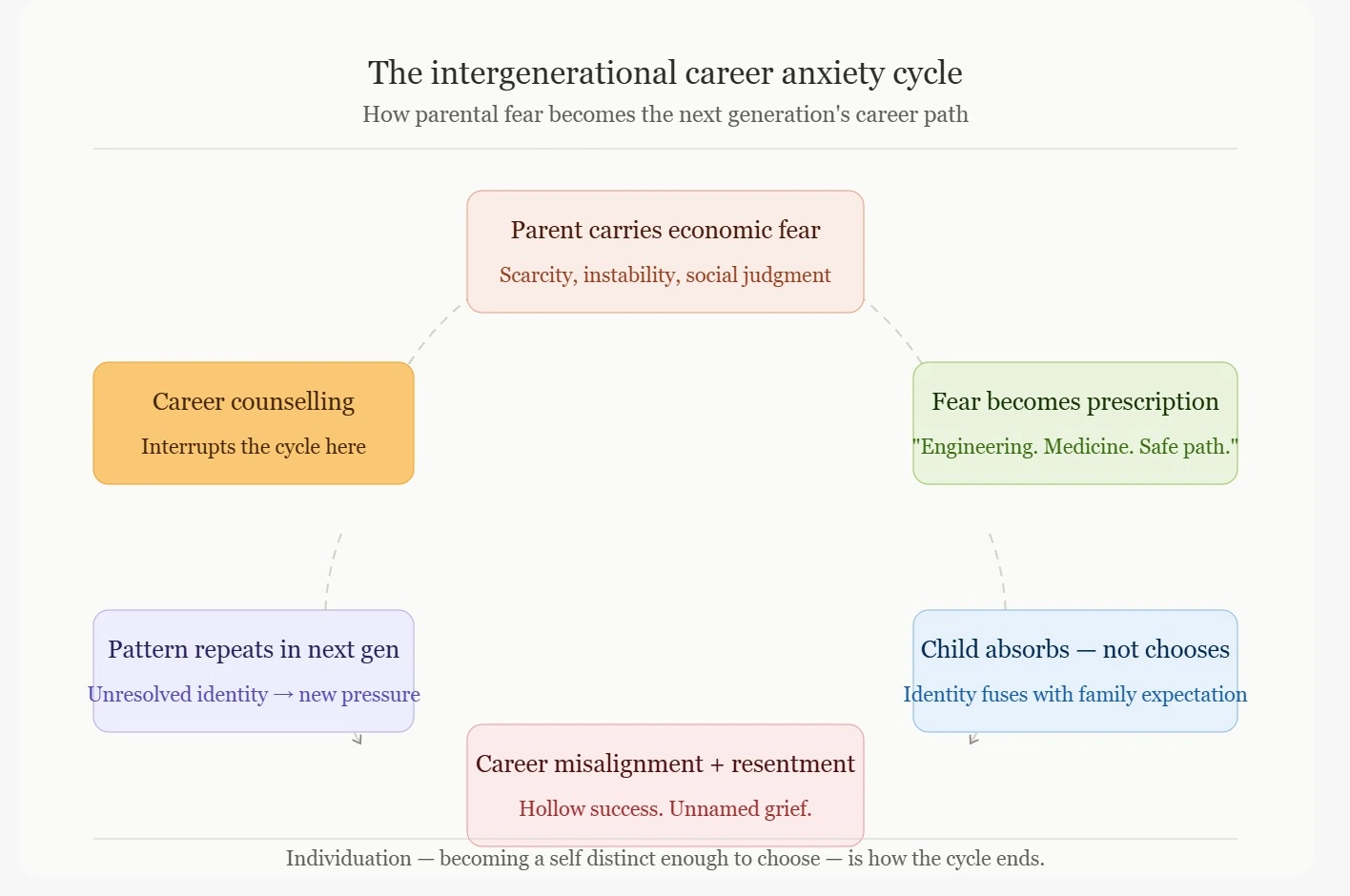
For a generation of Indian parents who grew up with genuine economic scarcity, job security was not a preference — it was survival. The parent who insists on engineering or medicine or a government job is often transmitting the anxiety of an era when the wrong career choice could mean genuine hardship. Their prescription is not tyranny. It is their deepest expression of love, filtered entirely through fear.
Psychologists call this intergenerational anxiety transmission — the unconscious passing of one generation's fears directly into the next generation's life choices. The child does not inherit just genes. They inherit their parents' unresolved relationship with uncertainty, failure, and social judgment.
The parent's fear: "I did not have security. My child must not know that feeling."
The transmission: "This career is safe. This career is respected. This is the path."
What the child receives: A roadmap drawn by someone else's fear — mistaken, in good faith, for wisdom.
Understanding this does not mean accepting it. It means approaching the situation with enough compassion for both parties to actually change it.
What psychology calls this — and why it matters
Family systems psychologists use the term enmeshment to describe family structures where individual identity becomes so fused with family identity that the boundaries between "what I want" and "what my family needs me to want" effectively disappear. In enmeshed family systems, a child's career choice is not experienced as a personal decision. It is experienced as a family decision — one that carries the weight of the family's honour, stability, and narrative about itself.
Enmeshment is not abuse. It often coexists with deep love, enormous sacrifice, and genuine care. But it produces a specific psychological outcome in the child: the inability to distinguish between their own desires and the desires they have absorbed from the family environment. By the time that child is twenty-five and choosing a career, the question "what do I actually want?" can feel genuinely unanswerable — not from laziness, but because the self that would want things has never been given space to develop.
Career counsellors across India encounter this pattern constantly. Not in dramatic form — not children who openly rebelled and were punished — but in the quieter, more insidious form of adults who chose careers they did not want, did so without ever naming it as a choice, and are now paying the psychological cost of a decade or more of misalignment.
Meera's story — successful, dutiful, and quietly disappearing
Meera was a chartered accountant in Chennai. She had qualified in the first attempt — something her parents mentioned at every family gathering with visible pride. She had a stable income, a well-matched marriage, and a professional reputation that consistently preceded her.
She described herself, at thirty-one, as feeling like she was watching her own life through glass. Present for all of it. Experiencing almost none of it.
She had wanted, at seventeen, to study literature. She had written quietly all through school — not poems for competitions, but essays, observations, long letters to herself that she never shared. Her father, a pragmatic man who had built a small business through discipline and sacrifice, had not needed to be unkind about it. He had simply not entertained the possibility. Literature was not a career. CA was a career. The conversation had lasted approximately fifteen minutes.
Meera had not resisted. She had loved her father. She had understood, even then, what the choice cost him to build the security she now had. And so she had buried the writing, qualified in the first attempt, and spent the next twelve years being extremely good at something that had never once felt like hers.
Career counselling did not tell Meera to leave her profession. It asked a different question entirely: what would it mean to bring the self that writes into the work that pays? Over eight months, Meera began exploring financial journalism, content strategy for investment platforms, and corporate communication. She did not abandon CA — she expanded around it. The glass wall thinned. Then it disappeared.
The long-term cost of a career chosen by someone else
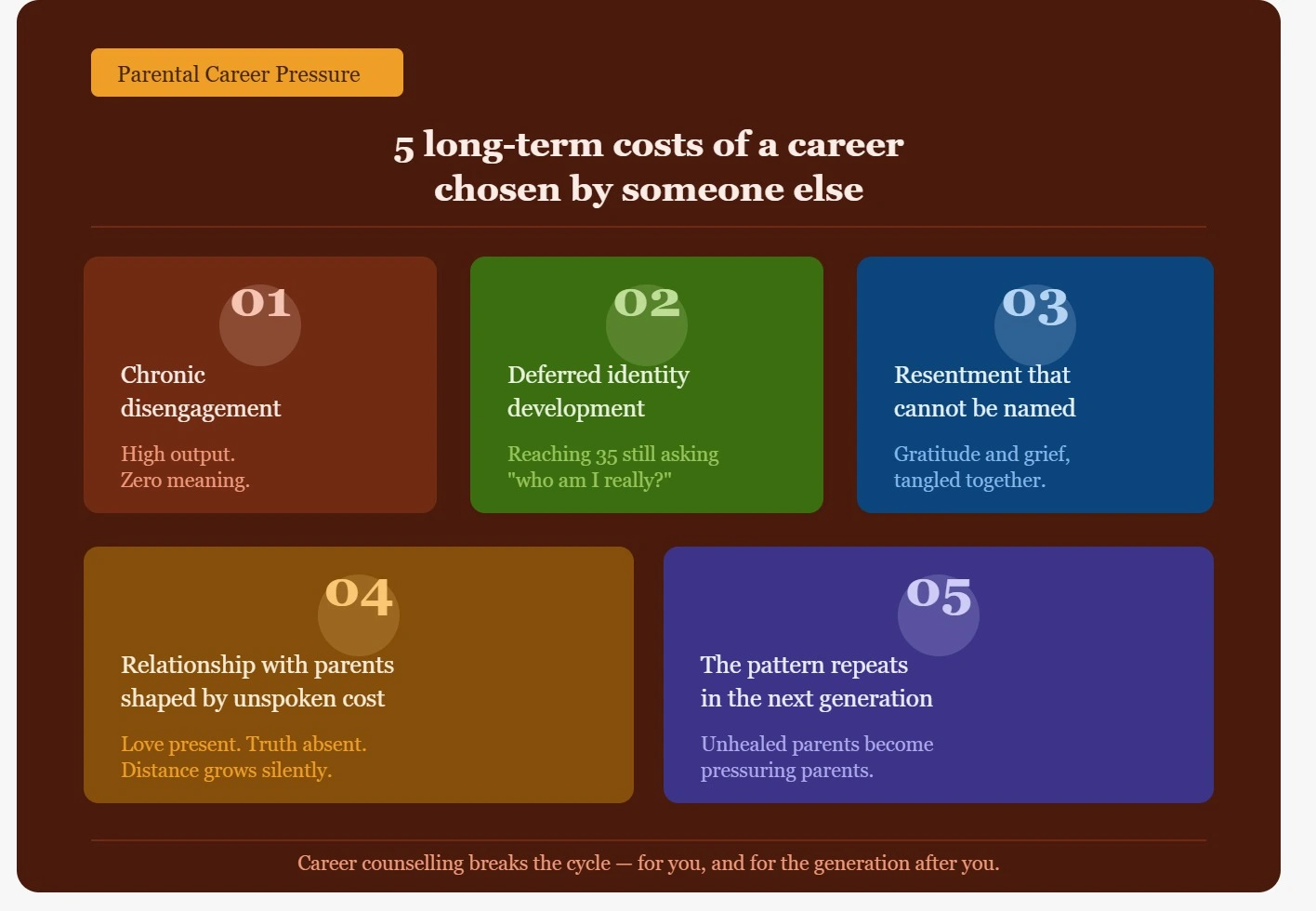
Chronic disengagement. People in misaligned careers do not necessarily perform badly. Many perform extremely well — the discipline that got them through a career they did not choose is often exceptional. But the internal experience of that performance is hollow. High output, low meaning. Sustainable for years. Corrosive over decades.
Deferred identity development. Psychologist Erik Erikson described identity formation as the central task of adolescence and early adulthood. When a young person's career — one of the primary vehicles for identity — is determined by external authority rather than internal exploration, that developmental task is interrupted. The person reaches thirty or forty still carrying an unresolved question about who they actually are. This is not a character flaw. It is a developmental consequence of having been loved in a particular way.
Resentment that cannot be named. Many people in parental-choice careers carry a low-grade resentment toward their parents that they cannot fully acknowledge because acknowledging it feels like ingratitude. The parents sacrificed. The parents meant well. The resentment feels monstrous in that context. And so it goes unnamed, and therefore unaddressed, and shapes relationships across the family for years.
The pattern repeating. The most significant long-term cost is not to the person who absorbed the pressure. It is to the next generation. An adult who never resolved their own career identity is far more likely to unconsciously replicate the same pattern with their own children — not from malice, but from having no alternative model to draw from. The cycle perpetuates not because anyone is cruel but because no one interrupted it.
What career counselling actually does in these situations
The role of career counselling in cases of parental career imposition is not to generate conflict. It is not to encourage rebellion, validate grievance, or advise people to abandon their families. It is to create, perhaps for the first time, a space in which the question "what do I actually want?" can be asked without the weight of family expectation in the room.
That sounds simple. It rarely is. For people who have spent twenty or thirty years answering that question with what their parents wanted to hear, the genuine version of the answer can be disorienting to encounter. Career counselling provides the framework — values clarification, strengths assessment, identity exploration — that makes the disorientation productive rather than overwhelming.
Crucially, the outcome is almost never "leave your career and start over." Most of the time, the work involves finding the thread of authentic self that still runs through even a heavily externally-determined career — and pulling that thread, carefully, until the work begins to feel inhabited rather than performed.
And sometimes, for younger clients who are still at the decision point, career counselling does something more immediate: it equips them with the language, the self-knowledge, and the professional data to have the conversation with their parents that changes the direction before it is too late. Not by arguing. By arriving at that dining table with something more powerful than resistance — a clear, informed, considered answer to the question their parents are actually asking, which is never really "what career do you want?" but always "will you be safe, respected, and okay?"
Conclusion
Your parents chose a career out of love. That is worth honouring. But love and wisdom are not the same thing — and a choice made out of someone else's fear, however well-intentioned, cannot produce a life that feels fully yours. You are not ungrateful for noticing this. You are not disloyal for wanting something different. You are simply, finally, asking the question that should have been asked long ago.
It is not too late. It is rarely too late. The self that was set aside at seventeen is not gone. It has simply been waiting — with remarkable patience — for permission to come back.
Career counselling is where that permission gets given. Not by a counsellor. By you — finally, in a room where someone asks the right questions and has the training to sit with the answers without flinching.
Ready to build a career that is finally yours?
Book a personalised career counselling session today.
Frequently asked questions
Is it common for Indian parents to choose careers for their children?
Extremely common — and significantly more prevalent in India than in many Western countries, for well-documented cultural and historical reasons. Research in occupational psychology consistently identifies family influence as the single most powerful determinant of career choice in the Indian context, outweighing both personal interest and aptitude in many families. This is not a pathology unique to Indian culture — it is a predictable outcome of collectivist family structures where individual decisions carry family-wide social and financial implications.
What is enmeshment in family psychology?
Enmeshment describes a family dynamic in which individual boundaries are so blurred that family members struggle to distinguish their own needs, feelings, and desires from those of the family unit. In highly enmeshed families, a child's career choice is experienced as a collective decision rather than a personal one — carrying implications for family honour, financial stability, and social identity. Enmeshment is not inherently abusive; it often coexists with genuine warmth and sacrifice. But it consistently produces adults who find the question "what do I want?" deeply difficult to answer with any independence.
How do I tell my parents I want a different career without hurting them?
The most effective approach is almost never direct confrontation — which activates defensiveness and rarely changes minds. Career counsellors typically advise building the conversation around the underlying concern your parents have, which is almost always about your security and respect, not about the specific career itself. Arriving with a clear, researched, specific plan for how an alternative career path produces those outcomes — supported by data, not just passion — changes the nature of the conversation entirely. It is no longer a child resisting. It is an adult proposing.
I am already ten years into a career I did not choose. Is it too late to change?
No — and ten years of professional experience is not a liability in a career transition, it is a substantial asset. The question is not whether to abandon everything but how to redirect what you have built toward work that fits you more honestly. Career counsellors working with mid-career clients consistently find that the transition is less about starting over and more about strategic repositioning — using the skills, credibility, and relationships built over ten years to move laterally toward work that is meaningfully different in its emotional experience, even when it remains adjacent in its professional domain.
Why do I feel guilty for wanting a different career when my parents sacrificed so much?
Because you were taught, implicitly or explicitly, that your fulfilment was less important than their sacrifice — and that wanting something different constitutes ingratitude. That belief is understandable given the context in which it was formed, but it is not accurate. Honouring a parent's sacrifice does not require living a life that does not fit you. The most enduring honour you can offer someone who sacrificed for your future is to actually inhabit that future with full engagement — not to perform gratitude through a career that drains you. These two things are not in conflict. A career counsellor can help you hold both.
How does career counselling help when the pressure is coming from family?
Career counselling creates a space outside the family system — perhaps the first such space many clients have ever had — to explore what they actually want without the weight of family expectation in the room. A trained counsellor helps the client distinguish between absorbed desires and genuine ones, build the self-knowledge needed to make an informed choice, and develop the communication strategy to have productive conversations with parents rather than unproductive confrontations. The goal is never estrangement. It is individuation — the healthy process of becoming a self distinct enough from the family to make genuine choices, while remaining connected enough to honour the relationships that shaped you.

Leave a Comment
To post comment, please