

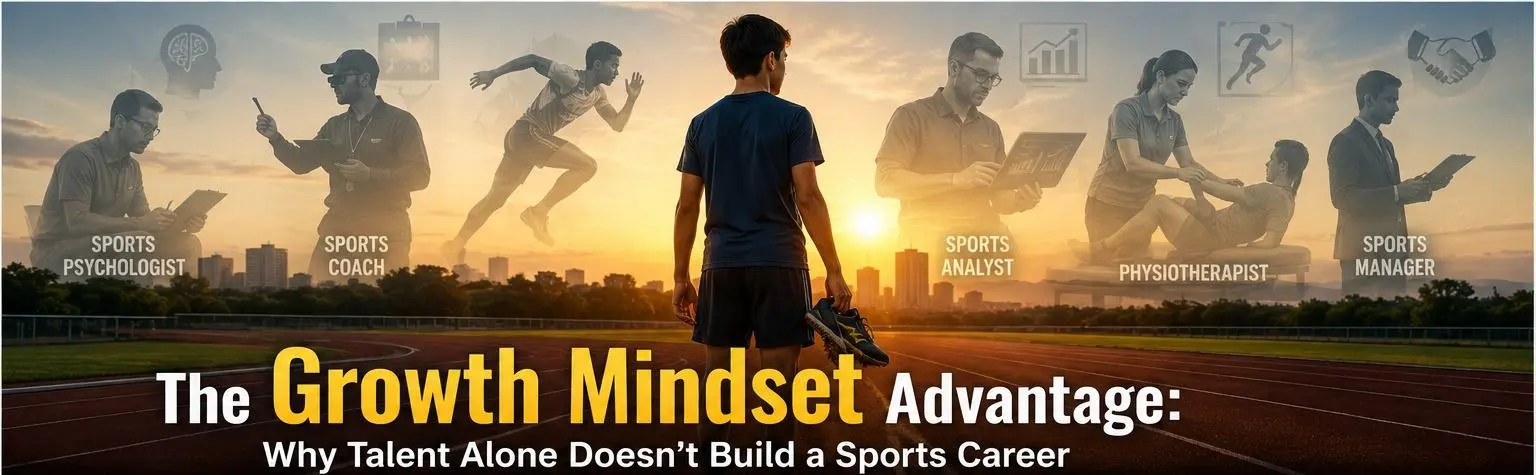
The Growth Mindset Advantage: Why Talent Alone Doesn't Build a Sports Career
"Some children are naturally talented."
This is one of the most common statements parents and coaches make when discussing sports. But what if success in sports depends less on natural talent and more on the belief that abilities can improve through effort, learning, and persistence?
This idea comes from Growth Mindset Theory, developed by Carol Dweck, a psychologist whose work transformed our understanding of achievement and motivation.
In today's competitive world of sports, where young athletes face intense pressure, injuries, selection trials, and constant comparison, a growth mindset may be one of the most valuable psychological tools for building a successful sports career.
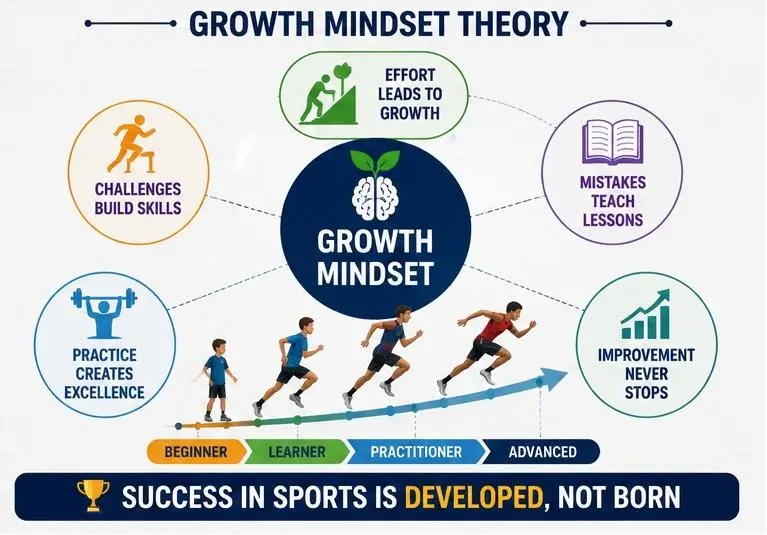
What is Growth Mindset Theory?
According to Growth Mindset Theory, people generally develop one of two beliefs about their abilities:
Fixed Mindset
Children with a fixed mindset believe:
- Talent is something you are born with.
- Success proves intelligence or ability.
- Failure means they are not good enough.
- Challenges should be avoided.
For example, a child who loses a football trial may conclude:
"I'm not talented enough for football."
Growth Mindset
Children with a growth mindset believe:
- Skills can be developed through practice.
- Mistakes are opportunities to learn.
- Effort leads to improvement.
- Challenges help them grow.
The same child might think:
"I didn't get selected this time. I'll improve my fitness and try again."
This simple difference in thinking can completely change an athlete's future.
Why Is Growth Mindset Important in Sports?
Sports careers are filled with obstacles.
Athletes experience:
- Defeats
- Injuries
- Competition
- Performance pressure
- Rejection during selections
- Public criticism
Without psychological resilience, many talented players leave sports too early.
A growth mindset helps athletes view setbacks as temporary rather than permanent.
Instead of asking:
"Why did I fail?"
They ask:
"What can I learn from this experience?"
This shift creates long-term success.
Real-Life Example: Michael Jordan
Michael Jordan is often considered one of the greatest basketball players in history.
However, many people are surprised to learn that he was cut from his high school varsity basketball team.
Instead of giving up, he used the rejection as motivation to improve.
His success was not built only on talent but also on persistence, discipline, and continuous learning—qualities strongly associated with a growth mindset.
Sports Careers Beyond Becoming an Athlete
One of the biggest misconceptions among students is that a sports career means becoming a professional player.
Today's sports industry offers many career options:
1. Sports Psychologist
Helps athletes manage stress, confidence, motivation, and performance anxiety.
2. Sports Nutritionist
Designs nutrition plans to improve performance and recovery.
3. Sports Physiotherapist
Works with athletes during injury rehabilitation and prevention.
4. Sports Analyst
Uses data and performance statistics to improve team strategies.
5. Sports Journalist
Reports on sporting events, athletes, and competitions.
6. Sports Manager
Handles athlete branding, sponsorships, events, and team operations.
7. Strength and Conditioning Coach
Develops fitness programs to enhance athletic performance.
A growth mindset is valuable in all of these careers because continuous learning is essential.
What Parents Can Do to Encourage a Growth Mindset
Many parents unintentionally praise talent rather than effort.
Instead of saying:
❌ "You are naturally gifted."
Try:
✅ "I am proud of how hard you worked."
Instead of:
❌ "Maybe sports aren't for you."
Try:
✅ "What did you learn from this experience?"
Research shows that praising effort, strategy, and persistence helps children develop resilience and confidence.
The Role of Career Counselling in Sports
Career counselling can help students:
- Explore sports-related careers.
- Understand their strengths and interests.
- Develop realistic career pathways.
- Build confidence after setbacks.
- Create long-term academic and sports goals.
Not every child will become an Olympic athlete, but many can build meaningful careers within the sports ecosystem.

Leave a Comment
To post comment, please