

If you've been following our previous blogs, you already know one thing—we believe that choosing the right career is more important than simply choosing the most popular one.
When students hear the word medical, one course immediately comes to mind—MBBS.
And honestly, that's understandable. From childhood, we're told that if you want to work in healthcare, you either become a doctor or... that's it.
But the healthcare industry tells a very different story.
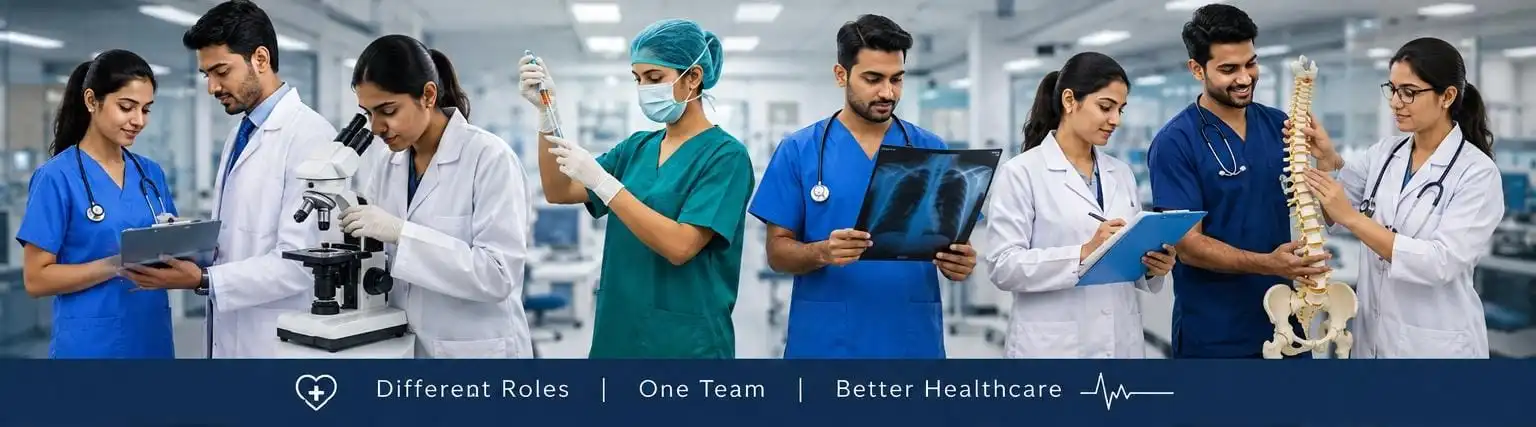
Walk into any hospital, diagnostic centre, rehabilitation clinic, IVF centre, or research laboratory. You'll notice something interesting. Doctors are certainly important, but they are never working alone. Every patient receives care from an entire team of professionals who are equally essential.
Today, healthcare has become one of the fastest-growing career sectors in India, creating opportunities that many students have never even heard about.
So, if you love biology, enjoy helping people, or simply want a career in healthcare, don't stop your search at MBBS. There is an entire world of possibilities waiting for you.
Clinical Careers – Where You Work Closely With Patients
Some students dream of treating patients face-to-face. They enjoy communication, solving problems, and making a direct difference in someone's life.
Clinical careers are perfect for them.
These include:
- MBBS (Doctor)
- Nursing
- Physiotherapy
- Clinical Psychology
- Counselling Psychology
Each profession plays a unique role in patient care. While doctors diagnose and prescribe treatments, nurses provide continuous care, physiotherapists help patients recover movement after injuries, and psychologists support mental health and emotional well-being.
The common thread? Every one of these professionals changes lives.
Diagnostic Careers – The Experts Behind Every Diagnosis
Before any treatment begins, doctors need answers.
That's where diagnostic professionals step in.
They analyse blood samples, perform imaging tests, study laboratory reports, and provide accurate information that helps doctors make the right decisions.
Popular options include:
- Medical Laboratory Technology (MLT)
- Radiology & Imaging Technology
- Pathology
- Medical Technology
If you're someone who enjoys science, precision, and technology more than direct patient interaction, this could be an excellent career choice.
Healthcare is becoming increasingly dependent on accurate diagnostics, making these professionals highly valuable.
Surgical & Operation Theatre Careers
Many students think only surgeons work inside an operation theatre.
The truth is that every successful surgery depends on a skilled team.
Operation Theatre Technicians, Surgical Assistants, and Anaesthesia Technicians prepare instruments, maintain sterile conditions, assist doctors during surgery, and monitor equipment to ensure everything runs safely.
It's a career for students who enjoy responsibility, teamwork, and working in high-pressure environments.
Public Health – Caring for Entire Communities
Not every healthcare professional treats patients one by one.
Some work to improve the health of thousands—or even millions—of people.
Public health professionals focus on disease prevention, health awareness, nutrition, research, vaccination programmes, and healthcare policies.
Career options include:
- Public Health Specialist
- Epidemiologist
- Health Educator
- Nutritionist
If making a large-scale social impact excites you, public health can be an incredibly fulfilling career.
Medical Research – Where Tomorrow's Treatments Begin
Every vaccine, medicine, and medical breakthrough starts with research.
Researchers spend years studying diseases, developing treatments, improving healthcare technology, and conducting clinical trials.
Career opportunities include:
- Biomedical Science
- Clinical Research
- Biotechnology
- Medical Sciences
For students who are naturally curious and enjoy experimenting, analysing data, and discovering new solutions, research offers endless opportunities to contribute to healthcare.
Specialized Paramedical Careers That Are Growing Rapidly
One of the biggest surprises for students is discovering just how many specialised careers exist in healthcare.
Let's look at some of them.
Cardiology Technology
Heart diseases are increasing worldwide, which has created a growing demand for Cardiac Technologists.
These professionals perform ECGs, assist during angiography, operate cardiac equipment, and support cardiologists in diagnosing heart conditions.
Embryology (IVF)
As fertility treatments become more common, Embryology has emerged as one of the most exciting healthcare careers.
Clinical embryologists work inside IVF laboratories, handle embryos, assist fertility specialists, and help couples achieve their dream of becoming parents.
Laboratory & Diagnostic Sciences
Laboratory professionals conduct blood tests, examine samples, prepare reports, and maintain quality standards.
Without their work, many diseases would remain undetected.
Physiotherapy & Rehabilitation
Recovery doesn't end after surgery.
Physiotherapists help patients walk again, regain strength after accidents, recover from sports injuries, and improve mobility after neurological conditions.
Their work often transforms a patient's quality of life.
Respiratory & Critical Care
Critical care professionals work with patients who require breathing support.
They manage ventilators, oxygen therapy, and assist ICU teams during emergencies.
This career became especially important during the COVID-19 pandemic and continues to remain in high demand.
Brain & Nervous System Technology
Students fascinated by neuroscience can choose careers in Neurophysiology.
These professionals perform EEG tests, nerve conduction studies, assist neurologists, and help diagnose disorders affecting the brain and nervous system.
Eye & Vision Care
Eye care professionals do much more than prescribe glasses.
They conduct vision tests, detect eye diseases early, assist ophthalmologists, and help people maintain healthy eyesight.
With increasing screen time, this field is growing steadily.
Operation Theatre & Equipment Technology
Operation Theatre Technicians prepare surgical equipment, sterilise instruments, organise operating rooms, and support surgeons throughout procedures.
Their role is crucial in ensuring patient safety during surgeries.
So... Which Career Is Right for You?
This is probably the biggest question students ask.
The answer isn't the same for everyone.
Instead of asking,
"Which course has the highest salary?"
try asking,
- What kind of work will I enjoy every day?
- Do I like interacting with patients?
- Am I more interested in technology or laboratory work?
- Do I enjoy research?
- What are my natural strengths?
The best career isn't necessarily the most famous one.
It's the one you'll enjoy building for the next 30 years.
Career counselling often helps students discover options they never knew existed—and sometimes those lesser-known careers turn out to be the perfect fit.
Final Thoughts
Healthcare has never been limited to MBBS.
Today, the medical field includes hundreds of career paths, each playing a vital role in improving lives.
Whether you dream of becoming a doctor, psychologist, physiotherapist, embryologist, laboratory scientist, cardiac technologist, or public health expert, every profession contributes to the same mission—helping people live healthier lives.
Your future shouldn't be decided by myths or social pressure.
It should be decided by your interests, your abilities, and the kind of impact you want to create.
Because in healthcare, every role matters.
Book Your Career Counselling Session Today
Still confused about NEET, MBBS, or other medical career options?
Frequently Asked Questions (FAQs)
1. Can I work in the medical field without qualifying for NEET?
Yes. Many healthcare careers do not require NEET. Courses like BSc Medical Laboratory Technology (MLT), Physiotherapy (BPT), Optometry, Radiology, Operation Theatre Technology, Respiratory Therapy, Biotechnology, Clinical Psychology, and several other paramedical programs offer excellent career opportunities without NEET. Admission criteria vary by college and university.
2. What are the best career options if I don't get an MBBS seat?
Not getting an MBBS seat doesn't mean your medical career is over. Students can explore careers such as Physiotherapy, Nursing, Medical Laboratory Technology, Radiology, Cardiac Technology, Embryology (IVF), Public Health, Clinical Research, Biotechnology, and Clinical Psychology. Many of these fields have strong demand, good salaries, and excellent growth opportunities.
3. Which paramedical course has the highest career scope in India?
Some of the fastest-growing paramedical careers include Medical Laboratory Technology (MLT), Radiology & Imaging Technology, Physiotherapy, Cardiac Technology, Respiratory Therapy, Operation Theatre Technology, Optometry, and Embryology (IVF). The right choice depends on your interests, skills, and long-term career goals.
4. Is NEET compulsory for every medical course?
No. NEET is mandatory primarily for MBBS, BDS, AYUSH, and some other medical programs. Many allied health science and paramedical courses admit students based on Class 12 marks or separate entrance examinations conducted by universities.
5. How can career counselling help me choose the right medical career?
Career counselling helps students understand their interests, aptitude, personality, and strengths before choosing a course. Instead of selecting a career based only on marks or trends, professional guidance helps identify medical and paramedical careers that match your abilities, improving both career satisfaction and long-term success.

Leave a Comment
To post comment, please