

You Have Infinite Options, a Thousand Opinions, and Absolutely No Idea What You Actually Want.
Gen Z · Social Media Psychology · Career Counselling
Open your phone for thirty seconds. Someone your age just got into IIM. Someone else just launched a startup that raised funding. A classmate from school is living in Berlin, posting photographs of their life that look like a film. A girl from your college is a content creator with 200,000 followers and appears to be thriving. An influencer you follow just announced they have cracked a government exam. Another one just became a UI designer and travels to Bali for the aesthetic.
All of this landed in your feed in the time it takes to ride an elevator.
Now someone is asking you what you want to do with your career. And you feel — not inspired, not motivated, not energised by the abundance of possibility — but paralysed. Like someone handed you a menu with ten thousand items and told you to choose, and now the waiter is still standing there, and you cannot decide, and every second you spend not deciding feels like falling behind.
This is not a Gen Z character flaw. It is a psychological phenomenon with a name, a mechanism, and — crucially — a solution. But to find the solution, you have to understand what is actually happening.
"The paradox of choice is not that having options is bad. It is that too many options, without a framework for evaluating them, produces not freedom but paralysis — and not satisfaction but regret."
— Adapted from Barry Schwartz, The Paradox of Choice
The psychology of too many choices — and why Gen Z is the most affected generation in history
American psychologist Barry Schwartz introduced the concept of the paradox of choice in 2004 — the counterintuitive finding that increasing the number of options available to a person does not increase their satisfaction. It increases their anxiety, their likelihood of making no choice at all, and their sense of regret about whichever choice they eventually make.
Schwartz was writing about consumer choices — jeans, jam, healthcare plans. He could not have imagined the scale at which his findings would apply to a generation of young people making career decisions in the age of social media.
Consider what previous generations faced when choosing careers. Limited exposure to options. A family environment that shaped the conversation. A broadly stable idea of what "success" looked like. The menu was short. The pressure was real but the decision space was manageable.
Gen Z faces an entirely different problem. They have seen every possible version of professional life — on Instagram, on LinkedIn, on YouTube, on TikTok — before they are eighteen. They know that you can be a data scientist, a sustainable fashion entrepreneur, a Bollywood casting director, a UX researcher, a travel photographer, a Chartered Accountant, a stand-up comedian, a public policy consultant, or a game developer. They have seen people thrive in all of these. And they are being asked, at twenty or twenty-two, to pick one — while being perpetually reminded that all the others are being lived, right now, by people who appear to be doing it better.
What FOMO does to a career decision
Fear of missing out — FOMO — was formally studied in psychology long before it entered common language. At its core, FOMO is the anxiety produced by the perception that others are having rewarding experiences from which you are absent. Social media did not invent FOMO. It industrialised it.
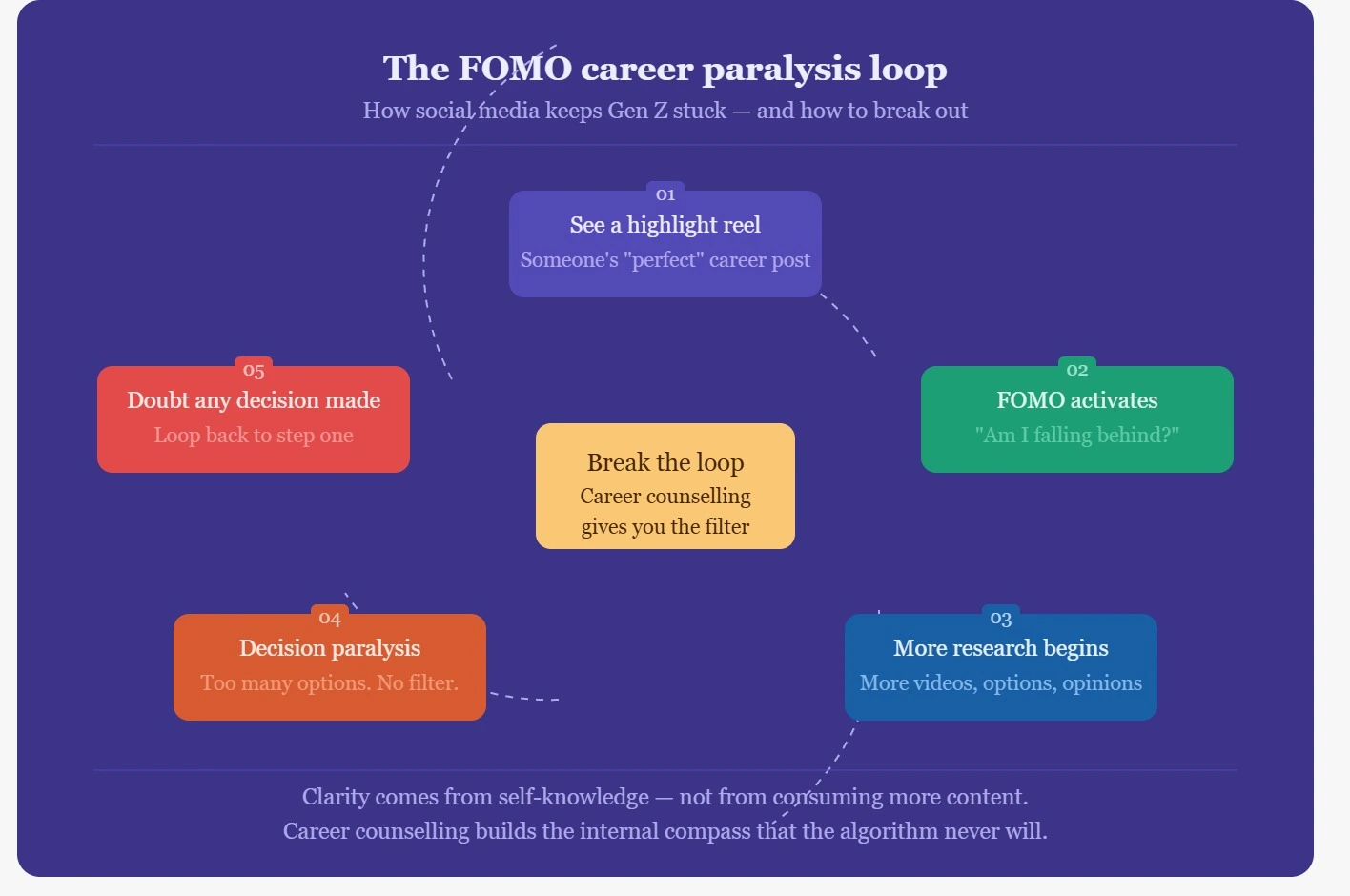
In a career context, FOMO produces a specific and debilitating pattern. The person cannot commit to a path because every path they choose immediately triggers awareness of all the paths they are not choosing. The moment they enrol in a law programme, they scroll past someone building a startup and wonder if they made a mistake. The moment they take a corporate job, they see a peer who went freelance and appears to have freedom, income, and sunsets all at once. The moment they choose, they begin mourning what they did not.
This is not rational. But it is not irrational either. It is the entirely predictable response of a human nervous system to a social environment that was not designed to support good decision-making — because social media was never designed to show you reality. It was designed to show you highlights. And highlights, consumed at volume and velocity, distort your sense of what is normal, what is achievable, and what you are missing.
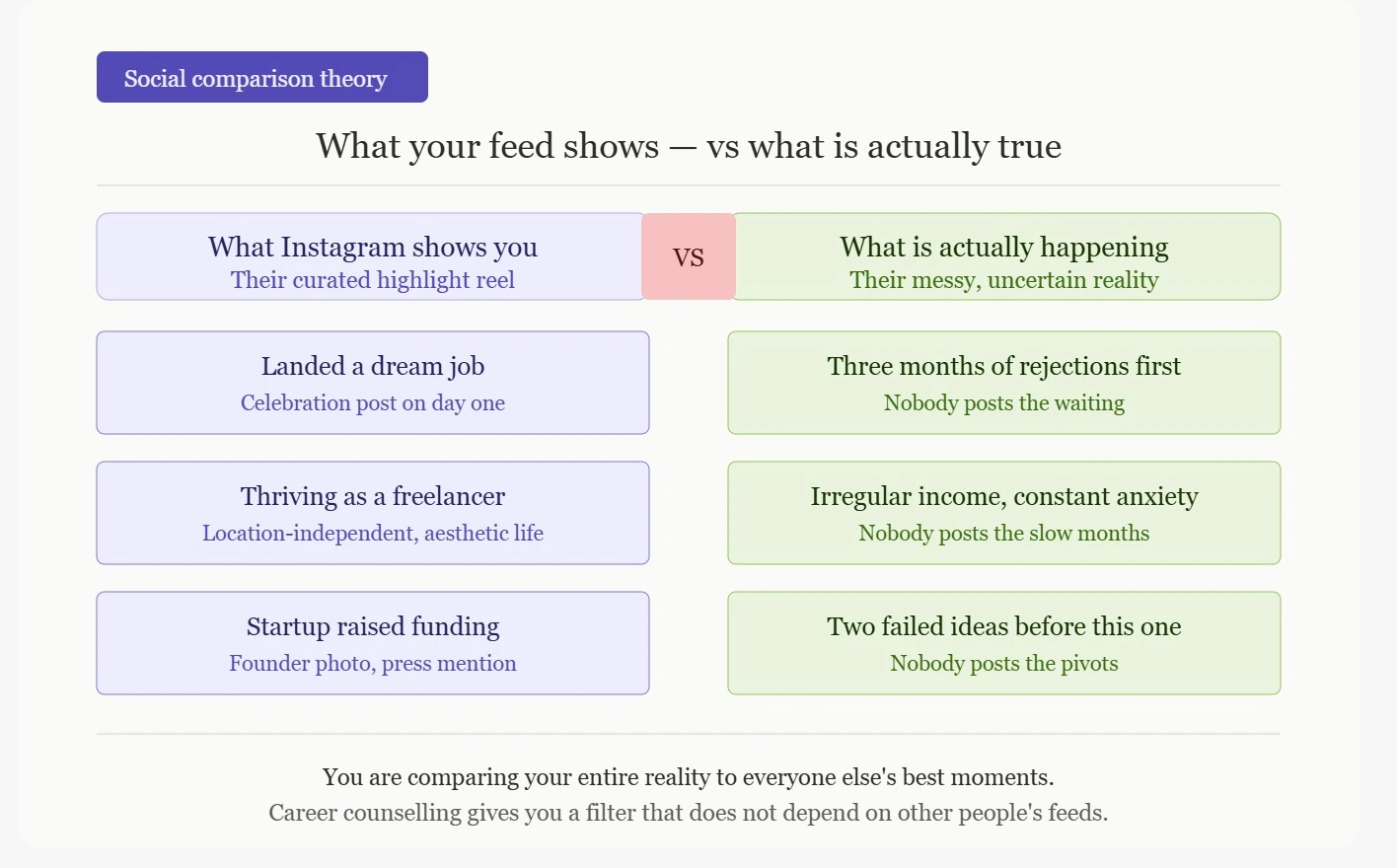
What you see on Instagram: Someone's best day, best angle, best caption, best filter.
What you compare it to: Your average Tuesday, your doubts, your unglamorous reality.
What your brain concludes: They are winning at life. I am behind. I have chosen wrong.
Psychologists call this social comparison theory — the well-documented human tendency to evaluate our own lives by comparing them to others. When your comparison pool was your neighbourhood, your school, your extended family, social comparison was manageable. When your comparison pool is every curated highlight reel of every person you have ever followed on every platform you have ever used, the comparison never resolves and the anxiety never rests.
Aryan's story — everything looked possible and nothing felt right
Aryan was twenty-three when he came to career counselling. He had completed a BBA, taken a year to "figure things out," watched approximately four hundred YouTube videos about career paths, read seven books on finding your purpose, started an MBA entrance preparation course he abandoned, and applied for three internships he did not follow up on.
He was not lazy. He was, if anything, over-informed. He could articulate the pros and cons of marketing versus finance versus consulting versus entrepreneurship with the fluency of someone who had researched all of them exhaustively. He knew what a product manager did, what a growth hacker did, what a management consultant's average week looked like. He had consumed more career information than most people encounter in a lifetime.
What he could not tell you — not because he had not thought about it but because the question had never been separated from the noise — was what he actually wanted. Every time he got close to an answer, another post, another video, another conversation reminded him of something he had not considered. The research had not clarified his thinking. It had crowded it.
Career counselling gave Aryan something no amount of content consumption could: a structured, guided process of self-inquiry. Not "what careers exist?" — he already knew. But "what do you specifically value, what are your actual strengths, and what kind of work makes you feel like yourself rather than like someone performing a version of success for an audience?"
Those questions — and the six weeks of work that followed — produced something Aryan had not experienced in two years of searching: clarity. Not certainty. Clarity. A direction specific enough to move toward, grounded enough to withstand the next impressive LinkedIn post that landed in his feed.
Why more information does not produce more clarity
This is the central misunderstanding that keeps Gen Z stuck. When you feel confused about your career, the instinct is to consume more — more research, more videos, more career quizzes, more advice from more people. Information feels like progress. It is not.
Career clarity does not come from knowing more about the options. It comes from knowing more about yourself. And self-knowledge — genuine, structured, psychologically grounded self-knowledge — is not available on YouTube. It requires a process, not a playlist.
Values clarification tells you what actually matters to you — not what you think should matter, not what your feed has convinced you to want, but the things that produce genuine engagement and meaning when they are present in your work.
Strengths assessment identifies what you do naturally well — not what you have trained yourself to perform, but the capacities that feel like flow rather than effort. For Gen Z, who have been performing curated versions of themselves since their early teens, this distinction can be genuinely revelatory.
Decision frameworks give you a way to evaluate options against your actual values rather than against someone else's highlight reel. When you know what you are optimising for, the infinite menu becomes navigable. Not because there are fewer options — but because you finally have a filter.
The LinkedIn illusion — why everyone looks more sorted than they are
One of the most important things a career counsellor can tell a young person is this: the people on LinkedIn whose careers look perfectly assembled are not actually more certain than you are. They are simply better at performing certainty. LinkedIn, even more than Instagram, is a platform of curated professional narratives — places where people publish the destination without the confusion, the title without the doubt, the achievement without the sleepless Sundays that preceded it.
This matters enormously because the comparison you are making is not between your reality and their reality. It is between your reality and their performance. And that comparison will always make you feel behind — not because you are, but because you are comparing two fundamentally different things.
Career confusion at twenty-two is not failure. It is the appropriate psychological response to genuine complexity, amplified by a media environment designed to maximise engagement rather than support good decisions. The generation that feels most confused is not the least capable. It may well be the most honest.
Conclusion
Your generation is not confused because it is weak, distracted, or entitled. It is confused because it is the first generation to make the most consequential decisions of its life while being simultaneously exposed to every possible version of how those decisions could go — curated, filtered, and algorithmically optimised to produce maximum envy and minimum context.
The answer is not to consume more information. It is not to spend another year researching. It is to stop looking outward for a moment and ask the question that no amount of scrolling can answer: not what careers exist, but what career exists for you — specifically, irreducibly, in the life you are actually living.
That question deserves a real conversation. Not a comment section. Not an algorithm. A person trained to ask it well — and to sit with you while you find your honest answer.
Ready to find clarity — not just more content?
Book a personalised career counselling session.
Frequently asked questions
Why is Gen Z so confused about careers?
Gen Z faces a unique combination of factors that no previous generation encountered at the same scale: unprecedented exposure to career options through social media, constant social comparison through curated highlight reels, a rapidly changing job market that makes long-term planning feel futile, and a cultural pressure to find not just employment but purpose and passion. The result is not laziness or indecisiveness — it is the predictable psychological outcome of too much external input and too little structured self-inquiry.
What is the paradox of choice and how does it affect career decisions?
Barry Schwartz's paradox of choice describes the counterintuitive finding that more options produce more anxiety, not more satisfaction. In career decisions, having more paths available does not make choosing easier — it makes it harder, because every commitment comes with awareness of everything being left behind. For Gen Z, exposed to more career paths through social media than any generation before them, the paradox operates at an extreme scale, producing decision paralysis, persistent dissatisfaction, and the constant feeling of having chosen wrong even before living the choice.
Does social media actually cause career confusion?
It significantly amplifies it. Social media does not cause confusion from nothing — but it consistently provides the raw material for social comparison, FOMO, and decision paralysis. When every career decision is made in an environment where the alternatives are constantly visible, curated, and optimised for envy, the psychological cost of committing to a path rises substantially. Research on social comparison and wellbeing consistently finds that heavy social media use correlates with lower career satisfaction and higher levels of occupational indecision among young adults.
How is career counselling different from watching career videos on YouTube?
YouTube career content tells you about careers. Career counselling helps you understand yourself in relation to careers. The former adds to your information load — which, as described above, often increases paralysis rather than reducing it. The latter uses validated psychological frameworks to identify your specific values, strengths, and motivations, then applies that self-knowledge to evaluate options intelligently. It is the difference between reading every item on the menu and having someone who knows you well say: based on everything I know about you, here are the three things worth considering seriously.
I keep changing my mind about what career I want. Is that normal?
Completely normal — and in a social media environment, almost inevitable. When your idea of what you want is constantly being refreshed by external input, consistency of preference becomes structurally impossible. The solution is not to force a decision and stick to it through willpower. It is to develop a stable internal framework — a clear sense of your values and strengths — that does not change every time you open Instagram. With that foundation, changing external options stop feeling threatening and start feeling like what they actually are: more material to evaluate with a filter you already have.
What is the first step to getting career clarity as a Gen Z person?
Stop consuming and start inquiring. Specifically: reduce the external noise — social media, YouTube, forums — for a defined period, and instead spend that time with questions directed inward. What have you done in your life, academic or otherwise, that produced genuine absorption rather than performed enthusiasm? What kind of problems do you find yourself thinking about without being asked to? What would you work on if no one was watching and no one would ever post about it? These questions feel simple. The answers, taken seriously, are the beginning of genuine career clarity — and a career counsellor is trained to help you sit with them honestly.

Leave a Comment
To post comment, please