

Why You Feel Stuck at Work: What Maslow Knew About Your Career That No One Told You
You wake up on a Monday morning and the dread hits before the alarm does. You have a stable job. A decent salary. Colleagues who are perfectly fine. And yet — something feels hollow. You scroll job boards not because you know what you want, but because something is clearly missing.
You're not lazy. You're not ungrateful. According to one of the most influential psychologists of the 20th century, you might simply be operating at the wrong level of your own needs.
Abraham Maslow and the question your career hasn't answered yet
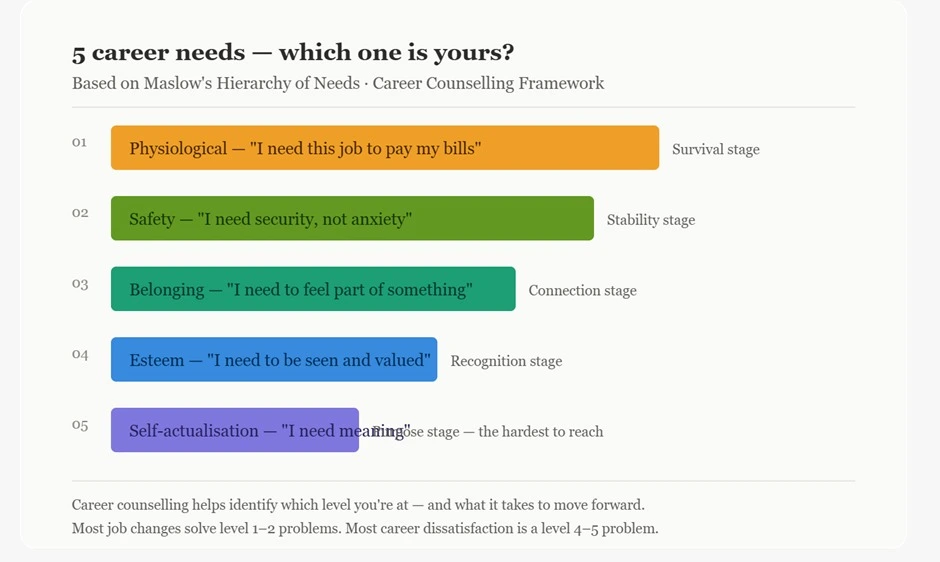
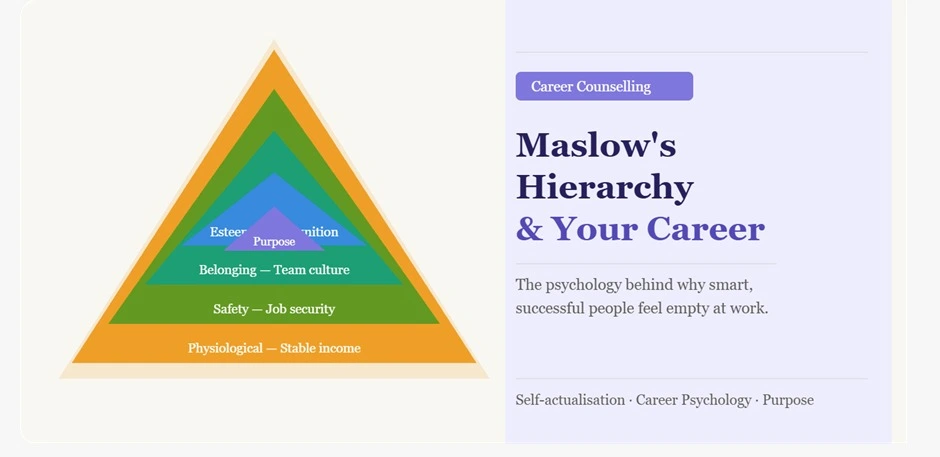
In 1943, psychologist Abraham Maslow proposed a framework that changed how the world thinks about human motivation. His Hierarchy of Needs — typically drawn as a pyramid — suggests that humans are driven by five layers of need, each building on the last:
Level 1 — Physiological: Food, shelter, income to survive
Level 2 — Safety: Job security, stable income, predictability
Level 3 — Belonging: Team connection, workplace culture, being valued
Level 4 — Esteem: Recognition, achievement, professional respect
Level 5 — Self-Actualisation: Doing work that feels meaningful, purposeful, true to who you are
Here's what most people miss: the salary that fixes Level 1 cannot fix a Level 5 problem. A promotion might temporarily silence the restlessness — but if your work fundamentally doesn't connect with who you are, the silence doesn't last.
Most careers are built from the bottom up — but most career crises happen at the top
Think about how most people choose their careers. They pick something that pays. Then they look for something secure. Then, if they're lucky, they find a team they like. Recognition comes next, maybe a title or two.
And then one day, often in their 30s or 40s, they look up and think: "Is this it?"
That feeling isn't a midlife crisis. It's a signal. It's Level 5 — self-actualisation — quietly knocking at the door. And it's the layer that career counselling, done properly, is built to address.
What career counselling actually does through a Maslow lens
Career counselling isn't just résumé advice. A trained career counsellor helps you identify which level of the pyramid your current job is actually meeting — and which ones it's leaving empty.
For example:
If you feel financially anxious despite earning well, it's often a Level 2 (safety) issue — perhaps job insecurity, unpredictable hours, or fear of redundancy. The goal isn't a higher salary; it's stability and control.
If you feel invisible at work, you're likely running a Level 3 or Level 4 deficit. You may need a role with more visibility, mentorship, or genuine collaboration — not just a new company.
If you feel purposeless despite external success, you're dealing with the hardest layer — self-actualisation. This is where the real career work begins: understanding your values, strengths, and what kind of contribution makes you feel alive.
Three questions Maslow's theory forces you to ask yourself
Before booking any career counselling session, sit with these honestly:
1. What am I actually getting from my work right now — survival, security, belonging, status, or meaning?
2. What is my work consistently failing to give me — and have I honestly named it?
3. Am I chasing a Level 1 or Level 2 solution (more money, safer job) for what is really a Level 4 or Level 5 problem?
Most people never ask the third question. That's exactly why they keep switching jobs and feeling the same.
Self-actualisation isn't a luxury — it's a career strategy
There's a persistent cultural myth that meaningful work is a privilege. That finding purpose is something you do after you've "made it." Maslow actually argued the opposite: humans are wired for growth, and when that drive is suppressed indefinitely, it doesn't disappear — it turns into disengagement, burnout, and the quiet desperation we mistake for personality.
People who find alignment between their values and their work don't just feel better — they perform better, stay longer, and contribute more. Self-actualisation is not the soft end of career planning. It is the point of it.
How to start applying this today
You don't need to overhaul your entire life this week. Start here:
Map your pyramid. Write down which needs your current job is meeting well and which it isn't. Be honest — not aspirational, not pessimistic. Just accurate.
Name the real gap. Is it money, security, respect, connection, or purpose? Most people conflate these. Separating them is where clarity begins.
Talk to someone trained to listen. A career counsellor won't tell you what to do. They'll ask the right questions until you tell yourself.
Frequently asked questions
What is Maslow's Hierarchy of Needs in the context of careers?
Maslow's Hierarchy of Needs is a psychological framework that organises human motivation into five levels — from basic survival needs up to self-actualisation. In a career context, it explains why a well-paying, secure job can still feel unfulfilling if it doesn't address your deeper needs for belonging, recognition, or meaningful work.
How does career counselling use psychology?
Career counsellors draw on psychological theories — including Maslow's, Holland's RIASEC model, and Super's Life-Span theory — to help clients understand what drives them, what their skills and values are, and which career paths genuinely align with who they are as a person, not just what the market pays for.
Can I feel self-actualised in any career or only certain ones?
Yes — self-actualisation isn't tied to a specific profession. A plumber and a professor can both feel deeply fulfilled or profoundly empty. It depends on whether the work challenges you appropriately, aligns with your core values, allows for growth, and gives you a sense that what you do matters to you personally.
When should I seek career counselling?
You don't need to be in crisis to seek career counselling. Common triggers include feeling stuck despite external success, repeated job-hopping without satisfaction, difficulty choosing between paths, returning to work after a break, or simply wanting to make a more intentional career decision rather than a reactive one.
Is the feeling of being "stuck" in a career a psychological problem?
Not in a clinical sense, but it often has psychological roots. Feeling stuck can reflect unmet needs (as Maslow's framework explains), unexamined beliefs about what you deserve or what's possible, fear of failure, or a mismatch between your current role and your authentic identity. A career counsellor can help untangle which of these is at play.
What's the difference between a career coach and a career counsellor?
A career coach typically focuses on forward-facing goals — interview skills, networking, productivity. A career counsellor brings psychological training to also address the deeper emotional and identity-based barriers that stop people from moving forward. If your problem is strategic, a coach helps. If it feels personal, counselling tends to go further.
Conclusion
Your career restlessness is not a character flaw — it is a signal worth listening to. Maslow spent his life proving that human beings are wired to grow, and no salary, title, or promotion can substitute for work that genuinely aligns with who you are. The pyramid doesn't lie: until you identify which need is truly unmet, you will keep solving the wrong problem.
For further information and personalised career counselling, because the right conversation at the right time can change the entire direction of your life.

Leave a Comment
To post comment, please