

You Are Sitting in the Room You Earned. Some Part of You Refuses to Believe It.
Career Psychology · Imposter Syndrome · Career Counselling
She has the credentials. The track record. The promotion letter with her name spelled correctly and her title typed in bold. She is, by every external and objective measure available to a hiring committee, exactly qualified for the role she now holds.
And she sits in meetings quietly convinced that everyone around the table is moments away from realising she does not belong there. That the promotion was a clerical error, a stroke of luck, a case of being in the right place when no better candidate happened to apply. She prepares twice as long as anyone else for every presentation, not because she lacks competence, but because she has never once trusted that her competence was real.
This is not a confidence problem in the way that phrase usually gets used. It has a specific psychological name, a documented history, and — crucially for anyone living inside it — a pattern of behaviour that quietly limits careers from the inside, long before any external obstacle ever gets the chance to.
"Imposter syndrome does not target the underqualified. It targets the achiever whose internal evidence has never been allowed to catch up with their external success."
.webp)
What imposter syndrome actually is — and where the term comes from
The term was coined in 1978 by psychologists Pauline Rose Clance and Suzanne Imes, who studied a striking pattern among high-achieving women: despite consistent external validation — degrees, awards, professional recognition — many of these women persistently attributed their success to luck, timing, or the ability to fool others, rather than to genuine competence. Clance and Imes called this the "imposter phenomenon," and decades of subsequent research have confirmed that it extends well beyond the population they originally studied, affecting high achievers across gender, profession, and culture.
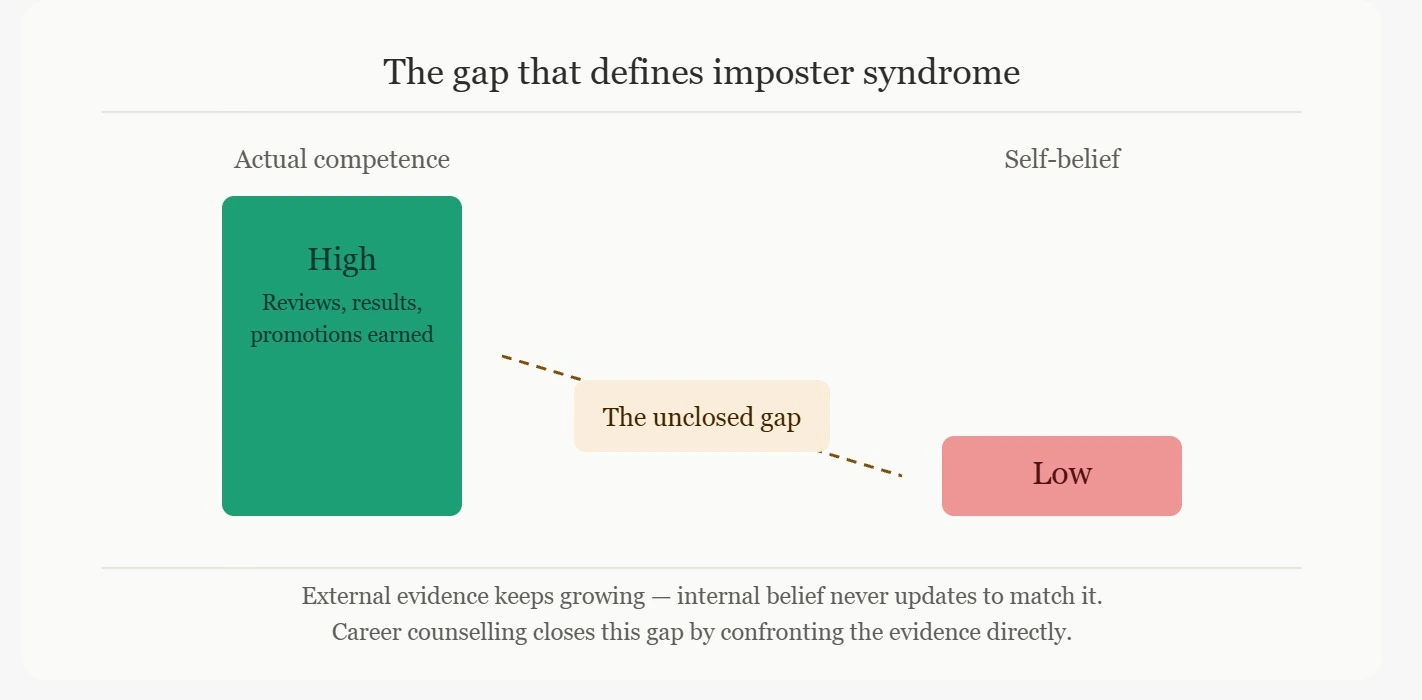
The defining feature is not low ability — quite the opposite. Imposter syndrome specifically affects people whose actual competence is high but whose internal sense of competence has never updated to match it. The result is a persistent, often exhausting gap between what a person has objectively achieved and what they privately believe they deserve to have achieved.
Why it specifically traps high achievers — not the underqualified
This is the part of imposter syndrome that surprises people who have not experienced it directly: it is not correlated with low competence. If anything, research consistently shows the opposite pattern — imposter syndrome is disproportionately common among people who are demonstrably excellent at what they do. Genuinely underqualified people are, somewhat famously, less likely to doubt themselves — a related phenomenon known as the Dunning-Kruger effect describes how limited competence can produce inflated confidence, almost the mirror image of imposter syndrome.
High achievers are particularly vulnerable for several specific reasons. First, they tend to hold themselves to standards calibrated against the most exceptional people in their field rather than realistic peer comparisons, which guarantees a perpetual sense of falling short. Second, they are disproportionately likely to have grown up in environments — frequently the topper culture and academic-pressure dynamics common in Indian households — where achievement was treated as the baseline expectation rather than something to be proud of, leaving little room to internalise success as earned rather than merely adequate. Third, and most insidiously, high achievers are skilled enough to attribute their wins to external factors with genuine plausibility — luck, timing, a generous evaluator — because their competence makes success look effortless even when it required real skill.
How imposter syndrome quietly sabotages careers
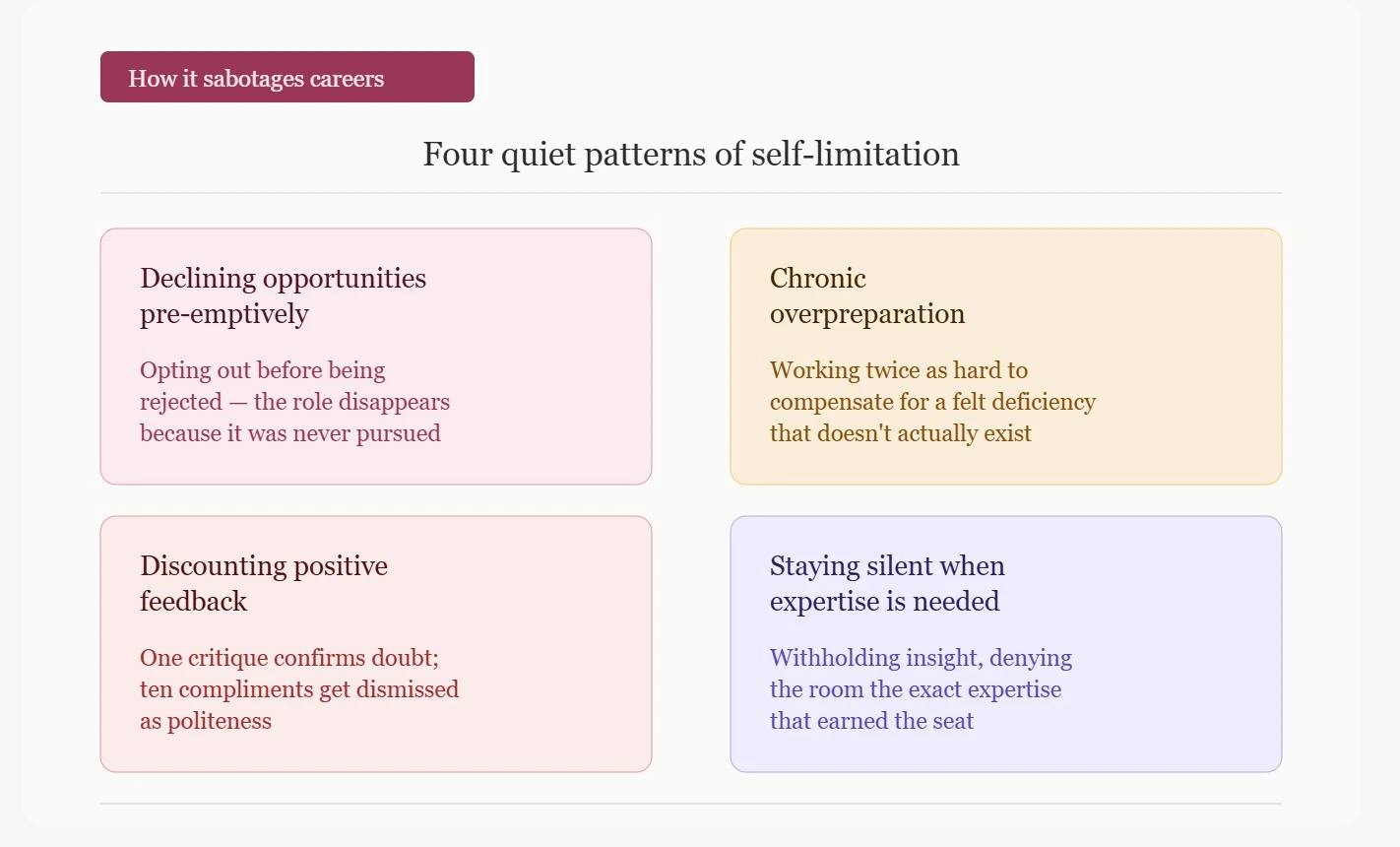
The damage imposter syndrome does is rarely dramatic. It does not usually announce itself as a crisis. It operates through a series of small, individually reasonable-seeming decisions that, accumulated over years, produce a career meaningfully smaller than the person's actual ability would justify.
Declining opportunities before being rejected. Many imposter-syndrome sufferers withdraw from promotions, stretch assignments, or visible projects pre-emptively — reasoning that it is safer to opt out than to be exposed as inadequate. The opportunity disappears not because it was denied, but because it was never pursued.
Chronic, exhausting overpreparation. Working twice as hard as objectively necessary to compensate for a felt deficiency that does not actually exist. This produces good short-term results and long-term burnout, since the underlying anxiety is never actually addressed by external performance, however strong.
Discounting positive feedback while amplifying criticism. A single critical comment is treated as confirmation of inadequacy; ten pieces of praise are dismissed as politeness, generosity, or evidence that the evaluator has not looked closely enough.
Staying silent in rooms where their expertise is needed. Withholding genuine insight out of fear that voicing it will somehow reveal a gap in knowledge — paradoxically denying the room access to exactly the expertise that earned them their seat at the table.
None of these behaviours look like sabotage from the inside. They feel like caution, humility, or diligence. From the outside, accumulated over a career, they look exactly like self-limitation — a talented person quietly building a career smaller than the one they were capable of.
Divya's story — the engineer who turned down the promotion twice
Divya was a senior software engineer at a technology firm in Bengaluru. She had been offered a team lead position twice in eighteen months and had declined both times, citing reasons that sounded reasonable in the moment — wanting more technical depth first, not feeling ready for people management, preferring to focus on her current projects.
When she came to career counselling — prompted, in part, by a mentor who gently pointed out the pattern — the underlying belief surfaced fairly quickly. Divya did not believe she was actually as technically strong as her reviews suggested. She attributed her consistently excellent performance reviews to having had unusually patient managers, to working on projects that happened to be forgiving of her gaps, and to simply not yet having been tested by something hard enough to expose her.
The career counselling process did not focus, at first, on the promotion decision itself. It focused on the evidence. Divya was asked to compile, methodically, every piece of concrete feedback she had received over four years — not her interpretation of it, the actual words used by actual managers and colleagues. The exercise, done properly, produced a body of evidence that directly contradicted the story she had been privately telling herself for years.
Divya accepted the team lead role the third time it was offered — not because the role had changed, but because she had finally examined evidence she had been unconsciously discounting for the length of her entire career.
Why willpower and confidence-boosting advice don't fix this
A common but largely ineffective response to imposter syndrome is generic encouragement — telling someone to "believe in themselves" or "fake it until you make it." This advice fails because imposter syndrome is not, at its core, a deficit of willpower or positive thinking. It is a distorted relationship with evidence — a systematic pattern of discounting data that contradicts an existing self-narrative while overweighting data that confirms it.
Telling someone with imposter syndrome to simply feel more confident is roughly as effective as telling someone with a fever to simply feel cooler. The intervention that actually works has to engage with the underlying cognitive pattern directly — confronting the specific, concrete evidence the person has been discounting, rather than offering generalised reassurance that bypasses the evidence problem entirely.
How career counselling addresses imposter syndrome differently
Building an evidence file, not a confidence speech. As in Divya's case, the most effective intervention is often disarmingly concrete: systematically documenting actual achievements, actual feedback, and actual outcomes, then directly confronting the gap between that evidence and the internal narrative.
Reframing attribution patterns. A career counsellor trained in cognitive approaches helps a client notice, in real time, the habit of attributing success to luck and failure to inadequacy — and practises the more accurate, more balanced alternative attribution that the evidence actually supports.
Separating the feeling from the decision. A central, practical skill is learning to notice the imposter feeling without automatically obeying it — pursuing the stretch assignment despite the doubt, rather than waiting for the doubt to disappear before acting, which for many high achievers, given the nature of the pattern, may never fully happen.
Conclusion
Imposter syndrome convinces its most capable victims of the one thing that is almost never actually true: that they do not deserve to be where they are. The evidence — the degrees, the reviews, the projects delivered, the trust extended by people who had every incentive to choose someone else — has been there all along. The work is not creating new evidence. It is finally being willing to look at the evidence that already exists.
You did not get this far by accident, however persuasively that story has been told to you by your own mind. Competence built the career. A distorted relationship with evidence is the only thing standing between you and trusting it.
The room was always yours. It is time the part of you that built it finally believed that too.
Ready to finally trust the evidence?
Book a personalised career counselling session with Allegiance Educare.
Frequently asked questions
What is imposter syndrome and who first identified it?
Imposter syndrome, originally called the "imposter phenomenon," was identified in 1978 by psychologists Pauline Rose Clance and Suzanne Imes. It describes a persistent pattern in which high-achieving individuals attribute their success to luck, timing, or deception rather than genuine ability, despite consistent external evidence of their competence. Decades of subsequent research have confirmed it affects high achievers broadly, across gender, profession, and culture, not just the population originally studied.
Why does imposter syndrome affect high achievers more than underqualified people?
High achievers tend to compare themselves against the most exceptional people in their field rather than realistic peers, hold themselves to standards that guarantee a perpetual sense of falling short, and are skilled enough to make external attributions for their success — luck, timing, generous evaluators — sound genuinely plausible. By contrast, genuinely underqualified individuals often display the opposite pattern, known as the Dunning-Kruger effect, in which limited competence is paired with inflated confidence rather than self-doubt.
How does imposter syndrome actually damage a career?
The damage is usually gradual rather than dramatic. It typically shows up as declining opportunities pre-emptively to avoid potential exposure, chronic overpreparation that leads to burnout, discounting positive feedback while disproportionately weighting criticism, and staying silent in professional settings where one's expertise is genuinely needed. None of these individually look like sabotage, but accumulated over a career, they reliably produce outcomes significantly smaller than the person's actual ability would justify.
Does "fake it until you make it" actually help with imposter syndrome?
Generally, no — at least not as a complete solution. Imposter syndrome is fundamentally a distorted relationship with evidence, not a simple confidence deficit that generic encouragement or performative confidence can resolve. While acting despite the feeling can be a useful practical step, durable change typically requires directly confronting the specific evidence a person has been unconsciously discounting, rather than papering over the underlying pattern with surface-level reassurance.
Is imposter syndrome more common in India due to academic pressure culture?
A growing body of observation and clinical experience suggests yes. Environments that treat high achievement as a baseline expectation rather than something to be proud of — common in academically intense Indian households and schools — give young people little opportunity to internalise their success as genuinely earned. This conditioning frequently follows people into adult careers, contributing to the pattern of high competence paired with persistent self-doubt that defines imposter syndrome.
How does career counselling help someone with imposter syndrome?
Career counselling addresses imposter syndrome through structured, evidence-based methods rather than generic encouragement — including systematically documenting concrete achievements and feedback to directly confront the gap between actual evidence and the internal narrative, identifying and reframing distorted attribution patterns, and building the practical skill of acting despite self-doubt rather than waiting for the doubt to resolve first. The goal is not to eliminate the feeling entirely but to stop letting it make career decisions on the person's behalf.

Leave a Comment
To post comment, please