

You Have a Degree. Your Family Is Proud. And You Have No Idea What to Do Next.
The photograph is framed on the wall. You in your graduation gown. Your parents standing beside you — your father in his best shirt, your mother with a smile she has been practising since you were eleven years old.
You are the first. The first in your entire family to hold a degree. And everyone around you is waiting — expectantly, lovingly, but unmistakably waiting — for you to now do something extraordinary with it.
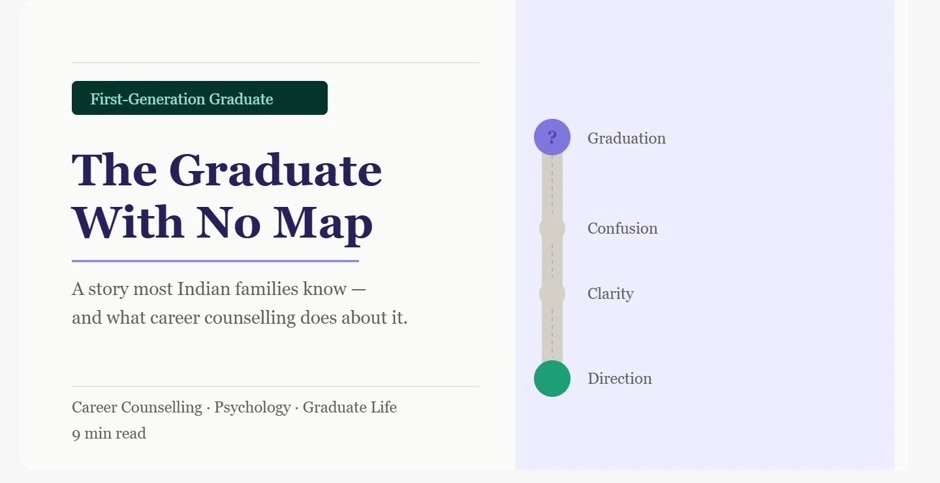
There is only one problem. Nobody in your family has ever walked this road before. There is no elder who can tell you which path to take after a BCom, a BCA, a BSc, a BA. There is no uncle who works in your field. There is no older sibling who has already figured out how LinkedIn works or what a cover letter is supposed to say. You are standing at the beginning of a journey that your family cheered you toward — and realising, quietly, that you are holding the map upside down and you do not even know it yet.
This is not a failure. This is one of the most common and least talked-about experiences of an entire generation of Indian graduates. And it has a name.
"Being the first in your family to graduate doesn't mean you're ahead. It means you're navigating without a compass — and that's a very different kind of challenge."
What it actually means to be a first-generation graduate
A first-generation graduate is someone whose parents did not attend college. In India, this group is enormous — and growing faster than any support system designed to help them has been able to keep up with.
The challenges are not just financial. In fact, for many families, the financial sacrifice has already been made. The deeper, less visible challenge is the knowledge gap — the absence of anyone in the family ecosystem who understands how professional careers are actually built.
When your father is a shopkeeper and your mother is a homemaker, nobody at your dinner table can tell you the difference between a government job and a corporate one, between a PG diploma and a certification course, between a good opportunity and a desperate one dressed up in a smart email. You have to learn all of this in real time, usually by making expensive mistakes, often while carrying the weight of an entire family's hopes on your back.
The psychological weight nobody talks about
Psychologist William Bridges, in his work on life transitions, described a crucial phase he called the neutral zone — a disorienting period between what was and what will be. It is not failure. It is not laziness. It is the uncomfortable, necessary passage that every major life transition requires.
For first-generation graduates, this neutral zone can last for years — because unlike their peers from professional families, they have no inherited script for what comes next. Their classmates from doctor or engineer families already know the route before they start walking. First-generation graduates have to find the road while they are walking it.
This creates a specific psychological pattern that career counsellors see regularly:
Paralysis by options — Too many choices with no framework to evaluate them
Imposter syndrome — Feeling unqualified for opportunities you have genuinely earned
People-pleasing career choices — Taking jobs to satisfy family rather than build a future
Chronic comparison — Measuring yourself against peers who started with inherited advantages
Fear of asking — Not wanting to appear ignorant in professional spaces
None of these are character flaws. They are the entirely rational responses of an intelligent person navigating an unfamiliar system without a guide.
Priya's story — a story most families will recognise
Priya graduated with a BSc in Computer Science from a state university in Maharashtra. Her parents — a retired government clerk and a tailoring teacher — had sacrificed substantially to get her through four years of college. She graduated with solid grades and a deep sense of obligation to now justify every rupee spent.
For two years after graduation, she applied to whatever she found on Naukri.com. She accepted a data entry position because it was the first offer she received and she did not know she was allowed to negotiate or wait. She enrolled in an MBA programme she did not want because her relatives told her it was the logical next step. She spent every evening feeling like she was falling behind — even though she was, by any objective measure, moving forward.
What Priya needed — and eventually found through career counselling — was not more information. She already had information. What she needed was someone to help her build a framework: how to evaluate opportunities, how to identify her actual strengths, how to separate what she genuinely wanted from what she had been told she should want.
Within eight months of that process, she had transitioned into a junior data analyst role at a mid-sized tech firm, earning more than her data entry job had paid in two years — doing work she found genuinely interesting.
Priya's story is not exceptional. It is representative of what becomes possible when direction replaces drift.
What the career system never taught you — but should have
Here are the things that children from professional families absorb at the dinner table — the things first-generation graduates often have to discover the hard way:
Your degree is a starting point, not a destination. A BCom graduate can work in finance, marketing, HR, operations, entrepreneurship, consulting, or education. The degree opens a door. A career counsellor helps you see all the rooms behind it.
Salary negotiation is not rude — it is expected. Most first-generation graduates accept the first offer out of relief and gratitude. This single habit costs them lakhs over a career. It is a negotiation, not a favour.
Networking is not nepotism — it is how professional worlds work. The discomfort many first-generation graduates feel in networking spaces comes from growing up in communities where asking for help was a vulnerability. In professional settings, it is a skill.
A bad first job is not a life sentence. Many first-generation graduates stay in unsuitable roles far longer than they should — because leaving feels ungrateful, because they worry the next opportunity might not come. It will come. And a career counsellor can help you leave well, not just leave.
Why career counselling matters more for first-generation graduates than anyone else
Career counselling is not a luxury for people who are already doing well. It is a levelling tool — one of the most effective ways to close the gap between those who grew up with professional guidance woven into their daily lives and those who did not.
A good career counsellor does not tell you what to do. They do something far more valuable: they help you build the internal navigation system that professional families spend eighteen years installing in their children. They help you understand your strengths through validated frameworks. They ask you the questions no one else in your life knows to ask. And they do it without judgement — because there is nothing to judge. You are not behind. You are unmapped. Those are very different things.
For further information and personalised career counselling, visit our website — because every first-generation graduate deserves a guide, not just a degree.
Conclusion
Your degree is not just a certificate — it is proof that you did something no one in your family had done before, entirely without a roadmap, and you did it anyway. That takes more than intelligence; it takes a particular kind of courage that most people never have to develop.
But the journey does not end at graduation — it begins there. And the next chapter deserves the same seriousness that got you through the first one. You do not have to navigate professional life the way you navigated college: alone, by guesswork, hoping the next step reveals itself before the current one runs out.
Career counselling is not an admission that you are lost. It is the decision to stop being unmapped.
Ready to find your direction?
Book a personalised career counselling session today. The clarity it gives you is worth everything. Visit our website to get started.
Frequently asked questions
What is a first-generation graduate?
A first-generation graduate is someone who is the first in their immediate family to complete a college or university degree. This means neither parent attended higher education, which creates a unique set of challenges around career navigation, professional networking, and workplace expectations that students from professional family backgrounds rarely face.
Why do first-generation graduates struggle more with career decisions?
The core challenge is a lack of inherited professional knowledge. Children from professional families absorb career frameworks, salary expectations, networking norms, and job market literacy through daily family conversations over many years. First-generation graduates have to learn all of this from scratch, often while managing financial pressure, family expectations, and imposter syndrome simultaneously.
I graduated two years ago and still feel directionless. Is that normal?
Completely. Career clarity rarely arrives on a schedule, and for first-generation graduates navigating without professional guidance, the timeline is almost always longer. Two years of confusion after graduation is not a sign of failure — it is a sign that you have been searching without the right tools. That is exactly what career counselling addresses.
How can career counselling help a first-generation graduate specifically?
A career counsellor provides what the family environment couldn't: a structured process to identify strengths, clarify values, evaluate options, and build a realistic career plan. For first-generation graduates specifically, this often includes reframing imposter syndrome, understanding the unspoken rules of professional environments, and separating genuine ambition from borrowed expectations.
My parents want me to take a government job for security. How do I balance that with what I actually want?
This is one of the most common tensions career counsellors work through with first-generation graduates in India. The desire for security is entirely valid — especially in families that have experienced financial uncertainty. A good career counsellor helps you evaluate both the security your family needs and the fulfilment you need, and find a path that honours both rather than sacrificing one for the other.
Is career counselling only for people who don't know what they want?
No — and this is an important misconception. Career counselling is just as valuable when you know what you want but don't know how to get there, when you have too many options and need help evaluating them, or when you have been in the wrong role for years and need to build a credible transition plan. Clarity of direction and clarity of path are two different things, and counselling helps with both.

Leave a Comment
To post comment, please