

You Were Supposed to Have This Figured Out by Now. So Why Does Thirty-Five Feel Like Sixteen Again?
Erikson's Psychology · Identity Development · Career Counselling
You have a career. A title that sounds respectable when you say it at a dinner party. Perhaps a spouse, a child, a flat with furniture you chose deliberately rather than inherited. By every external measure available, you are an adult who has arrived somewhere.
And yet, somewhere around your thirty-fifth year, a question starts surfacing that you thought you had answered at nineteen. Who am I, actually? Is this the life I am supposed to be living, or the life I simply ended up in?
You tell no one. It feels embarrassing — a question for teenagers, not for someone with a mortgage and a LinkedIn profile that looks entirely sorted. But the question is not embarrassing. It is, according to one of the most important developmental psychologists of the twentieth century, exactly on schedule for a generation that delayed the work it was originally meant to do.
"Identity is never established as an achievement... it is a process subject to the vicissitudes of existence." — Erik Erikson
Who was Erik Erikson — and what did he actually say about identity?
Erik Erikson, a German-American developmental psychologist, proposed in the mid-twentieth century that human development unfolds across eight distinct psychosocial stages, each defined by a central tension that must be resolved before a person can move forward with psychological stability. His fifth stage — identity versus role confusion — occurs, in his original framework, during adolescence. It is the stage in which a young person is meant to ask "who am I?" and arrive at a coherent answer that integrates their values, beliefs, relationships, and aspirations into something resembling a stable self.
Erikson believed that if this stage is not adequately resolved — if a person moves through adolescence without genuinely confronting the identity question — the unresolved tension does not disappear. It waits. And it resurfaces later in life, often during a period that looks, from the outside, like success.
This is precisely what is happening to a substantial number of people in their thirties today — particularly in cultures, like much of urban India, where adolescence is structured almost entirely around academic performance and career direction is handed down rather than discovered. The identity question was never asked at nineteen because there was no space for it. It is being asked now, at thirty-five, because the question does not expire. It simply waits for room.
.webp)
Why delayed identity formation is the norm, not the exception, in India
In Erikson's original Western context, adolescence was understood as a relatively protected period for identity exploration — a so-called psychosocial moratorium, a sanctioned pause before adult commitments, during which a young person could experiment with different roles, beliefs, and relationships before settling into a stable identity.
For most Indian adolescents, that moratorium barely exists. The years that Erikson identified as critical for identity exploration are, in practice, almost entirely consumed by board exam preparation, entrance coaching, and a narrow set of career tracks decided well before the person doing the deciding has had any real opportunity to discover who they are. There is no space to experiment with identity when every year between fourteen and twenty-two is structured around a single, high-stakes outcome.
The consequence, predictable from Erikson's framework, is not that identity development fails to happen. It is that it gets postponed — and resurfaces later, usually once the external structure that suppressed it (school, exams, the immediate pressure of getting a first job) finally loosens its grip. For many people, that loosening happens precisely in their early-to-mid thirties: established enough in a career to have some breathing room, stable enough in life circumstances to finally notice the question that was never asked.
What a delayed identity crisis looks like at thirty-five — and why it differs from a teenage one
An identity crisis at thirty-five carries a weight that a teenage one does not, for a simple reason: there is now far more at stake. A nineteen-year-old questioning their identity has relatively few entrenched commitments. A thirty-five-year-old questioning theirs may have a career trajectory, a marriage, children, a mortgage, and a professional reputation — all built, often unconsciously, around an identity that may not have been genuinely examined in the first place.
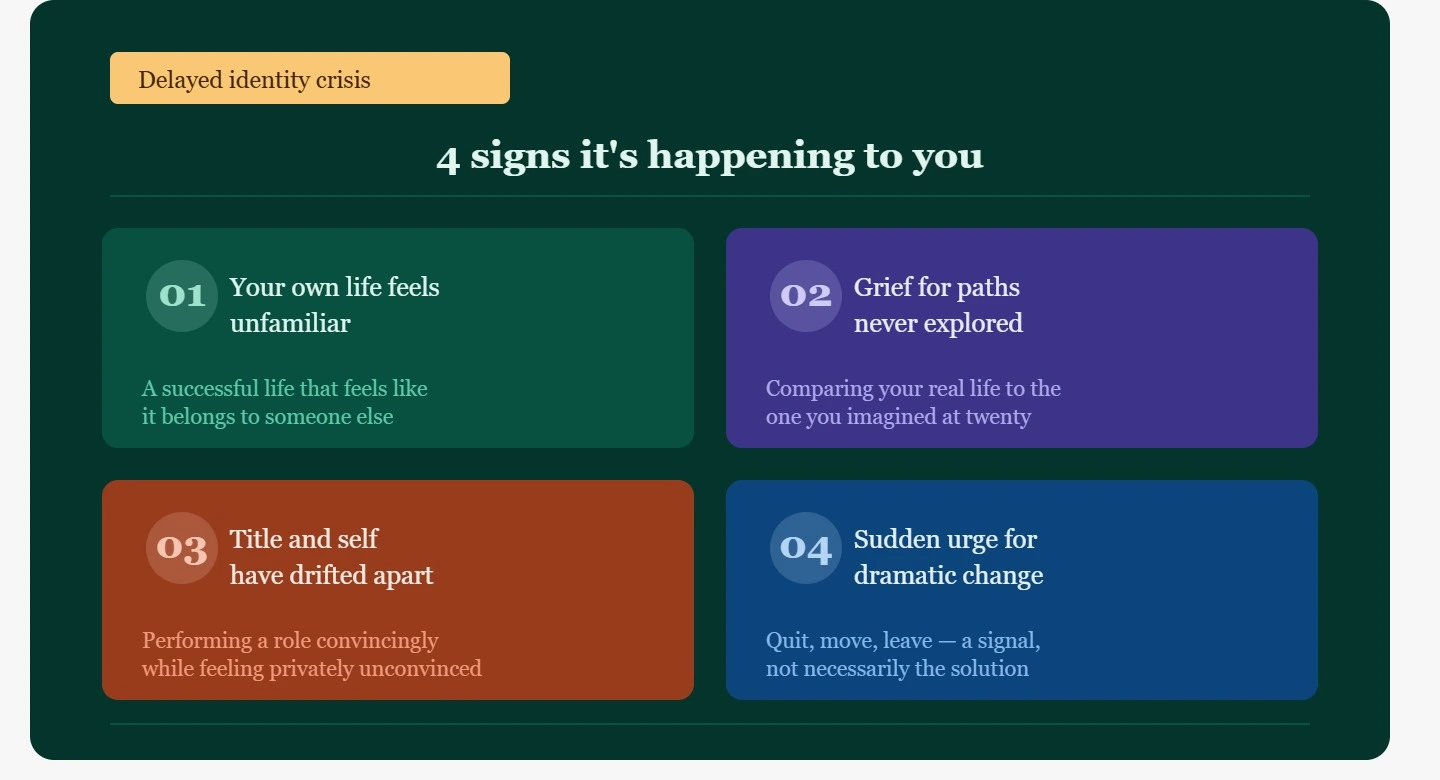
A sudden, disorienting sense of unfamiliarity with a life that, from the outside, looks entirely chosen and entirely fine.
Persistent comparison to the version of yourself you imagined at twenty — and a quiet grief for paths that were never explored.
A felt gap between your professional title and your internal sense of self — performing a role convincingly while feeling privately unconvinced by it.
An urge to make a dramatic change — quit the job, end the relationship, move abroad — that may or may not reflect what is actually needed, but reliably signals that something unresolved is finally surfacing.
This pattern is sometimes dismissed, particularly by people who have not experienced it, as a midlife crisis — a cliché involving impulsive decisions and a vague sense of restlessness. Erikson's framework suggests something more precise and, frankly, more legitimate: this is not a crisis of ageing. It is the identity work that should have happened fifteen years earlier, finally demanding to be done.
Kabir's story — a perfectly good career and a stranger in the mirror
Kabir was thirty-six and a senior manager at a logistics company in Delhi. He had been promoted three times in nine years. He had a wife, a young daughter, and a four-bedroom flat that he had worked hard to afford. On paper, there was no problem to solve.
He described the feeling that brought him to career counselling as standing in front of a mirror and genuinely not recognising the person looking back — not in a clinical, dissociative sense, but in the sense that the life reflected back at him felt like it belonged to someone he had been pretending to be for so long that he had lost track of who was underneath the performance.
Kabir had gone straight from a commerce degree his father had chosen into a logistics management programme that seemed practical, into a job that paid well and offered a clear trajectory. At no point in that sequence had Kabir been asked — by anyone, including himself — what he actually wanted. He had simply moved forward, competently, on a track laid down by other people's reasonable assumptions about what made sense.
Career counselling did not produce a dramatic resignation. It produced something Kabir had genuinely never done: a structured, serious inquiry into his own values, interests, and sense of meaning — fifteen years after Erikson would have expected that inquiry to occur. Over several months, Kabir identified a long-suppressed interest in operations strategy and process design — distinct from logistics execution, which is what he had been doing, and significantly more aligned with how his mind actually worked. He did not leave his company. He negotiated a transition into a strategy and process improvement role within it — a shift that felt, for the first time since his twenties, genuinely his.
Why this is not a failure — and what Erikson would actually advise
It is worth being direct about something many people in this situation believe privately and rarely say aloud: an identity crisis at thirty-five is often interpreted as evidence of failure — a sign of weakness, immaturity, or ingratitude toward a life that, by most measures, is going well. Erikson's framework suggests the opposite interpretation entirely.
Erikson believed that psychosocial development is never truly complete and that each stage can, in principle, be revisited and worked through later in life if it was not adequately resolved earlier. An identity crisis at thirty-five is not a sign that something has gone wrong. It is a sign that the psyche is finally doing necessary work that circumstances did not allow it to do at the appropriate time. The discomfort is not pathology. It is development, arriving late but arriving honestly.
This reframe matters enormously in practice, because how a person interprets the crisis determines how they respond to it. Treated as failure, the instinct is to suppress the feeling and push through. Treated as overdue development, the instinct is to finally engage with it — seriously, structurally, and without shame.
How career counselling supports identity work at any age
Career counselling is, in many respects, one of the most practical places in which adult identity work actually happens — even though it is rarely framed that way. Values clarification, strengths assessment, and structured self-reflection are not just career planning tools. They are the developmental tasks Erikson described as belonging to adolescence, conducted with the benefit of fifteen extra years of life experience.
A career counsellor working with someone in this situation is rarely focused on producing a dramatic life overhaul. The work is usually quieter and more precise: helping the person distinguish between the life they built by default and the life they would build with intention, then identifying what specifically needs to shift — sometimes substantially, more often incrementally — to close that gap.
For many people, that process alone — being taken seriously, asked the right questions, and given a structured way to think through an identity question they have carried silently for years — resolves more of the crisis than any external change ever could.
Conclusion
The question surfacing at thirty-five is not a sign that your life has gone wrong. It is the question that should have been asked at nineteen, finally finding the room it was always owed. You are not behind. You are not broken. You are simply doing, later than expected, the work that every stable identity eventually requires.
There is no shame in arriving at this question later than the textbook predicted. The textbook was written for a different life than the one most people in India were actually given to live. What matters now is not the timing. It is whether you finally give the question the seriousness it deserves.
Erikson was right that identity is never finished. He would also tell you: better at thirty-five than never at all.
Ready to finally answer who you actually are?
Book a personalised career counselling session by Allegiance Educare.
Frequently asked questions
What is Erikson's identity versus role confusion stage?
Identity versus role confusion is the fifth of Erik Erikson's eight psychosocial stages of development, originally associated with adolescence. It describes the central developmental task of forming a coherent sense of self — integrating values, beliefs, relationships, and goals into a stable identity. Erikson believed that failing to adequately resolve this stage does not eliminate the need to do so; it postpones it, often resurfacing later in life during periods that otherwise look externally successful.
Can you really have an identity crisis as an adult, not just as a teenager?
Yes — and contemporary developmental psychology has moved well beyond Erikson's original age-bound stages to recognise that identity development is an ongoing, lifelong process rather than a task completed once in adolescence. Adults who did not have adequate space to explore identity during their teenage years — common in academically intense or family-directed environments — frequently experience a delayed identity crisis later, often in their thirties, once external pressures finally loosen enough to allow the question to surface.
Why do so many Indian professionals experience identity confusion in their thirties?
A significant factor is the structure of adolescence in much of urban India, where the years Erikson identified as critical for identity exploration are heavily consumed by board exams, entrance coaching, and career paths often decided by family rather than personal discovery. With little space for genuine identity exploration during the teenage years, that developmental work is frequently postponed until early-to-mid adulthood, when career stability finally creates the breathing room for the question to resurface.
Is a midlife identity crisis the same as depression?
Not necessarily, though the two can overlap and should be distinguished carefully. An identity crisis, in Erikson's sense, is typically characterised by disorientation, questioning, and a search for meaning rather than the persistent sadness, hopelessness, and loss of function associated with clinical depression. If feelings of low mood, loss of interest, or hopelessness are severe, persistent, or affecting daily functioning, it is important to consult a mental health professional rather than treating it purely as an identity or career question. A career counsellor can help with the identity dimension, and will refer appropriately if clinical support is also needed.
Do I need to make a dramatic change if I'm having an identity crisis at work?
Rarely, and acting on the impulse for dramatic change before doing the underlying identity work often reproduces the same dissatisfaction in a new context. The more reliable path, as seen in cases like Kabir's, is structured self-inquiry first — understanding what specifically feels misaligned — followed by a deliberate, often incremental shift that closes that gap. Dramatic resignations made in the heat of an identity crisis, without that groundwork, are one of the most common sources of regretted career decisions that counsellors encounter.
How does career counselling help with an identity crisis specifically?
Career counselling provides structured tools — values clarification, strengths assessment, guided self-reflection — that closely mirror the developmental work Erikson associated with adolescent identity formation, now applied with the benefit of adult life experience. Rather than treating the crisis as something to suppress or rush past, a counsellor helps the person engage with it directly: distinguishing the life built by default from the life that would reflect genuine intention, and identifying realistic, often gradual steps to close that gap without requiring the dramatic upheaval the crisis can initially seem to demand.

Leave a Comment
To post comment, please