

You Were the Topper. So Why Does Your Career Feel Like You're Failing?
Teen Life & Career Psychology · Academic Burnout · Career Counselling
You spent twelve years being the answer. The one the teacher called on. The one whose mark was read out loud. The one the family referenced at every gathering — "Ask Arjun, he knows everything."
You were not just a good student. You were the good student. And that distinction — small as it sounds — shaped everything about how you understand yourself, how you measure your worth, and how completely unprepared you were for the moment the exam system ended and real life began.
Because in real life, there is no mark sheet. No rank. No teacher handing back a paper with 98/100 and a star. And for a person who built their entire identity around performing under those exact conditions, that absence is not liberating. It is terrifying.
"The tragedy of the topper is not that they fail. It is that they never learned who they were when no one was watching the scoreboard."
What topper burnout actually is
Burnout is not just exhaustion. According to psychologists Christina Maslach and Michael Leiter — whose work on burnout remains the global standard — burnout is a syndrome with three distinct dimensions: emotional exhaustion, depersonalisation, and a reduced sense of personal accomplishment.
For toppers, the third dimension is the most dangerous. Their entire self-concept is built around accomplishment — specifically, external, measurable, validated accomplishment. When that external validation disappears — as it inevitably does when school ends — the internal scaffold collapses. They feel like frauds. They feel empty. They push harder to recreate the feeling of the gold star, often in careers that were chosen not because they were meaningful but because they sounded impressive enough to justify the identity.
This is topper burnout. And it begins not in the workplace. It begins in Class 6.
The psychology behind why high achievers crash
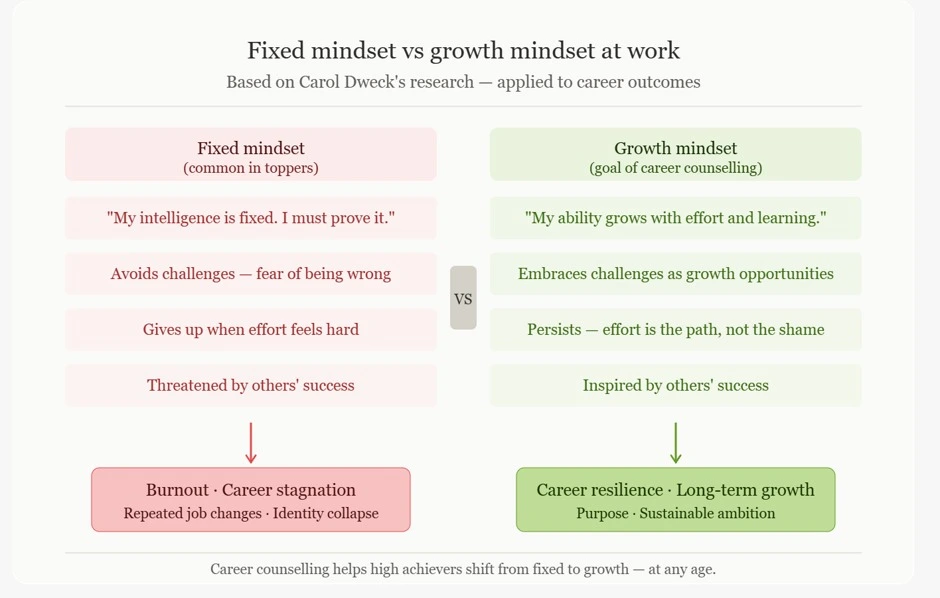
Carol Dweck's research on mindset at Stanford gives us one of the most useful frameworks for understanding this pattern. Dweck identified two distinct orientations toward ability and performance:
Fixed mindset — "I am intelligent. My results prove it. Failure means I am not." Students raised on rank-based validation overwhelmingly develop this orientation. Achievement becomes identity — not a process, not a journey, but a verdict about who you fundamentally are.
Growth mindset — "I can develop my abilities through effort and learning. A setback is information, not a sentence." This orientation — which Dweck's research consistently links to long-term resilience and career success — is precisely what the topper system dismantles.
The irony is devastating: the system that rewards intelligence trains children to be terrified of it. A topper who has never been allowed to fail — never been allowed to struggle, make mistakes, and recover — arrives in adulthood with brilliant results and a paper-thin relationship with difficulty. The first real professional challenge does not build them. It breaks them. Because no one ever told them that breaking and rebuilding was supposed to be part of it.
Neha's story — the 97% who felt like nothing
Neha scored among the top percentile in her boards. She got into a prestigious engineering college. She graduated with distinction. She was recruited directly by a Pune-based tech firm where, within two years, she was promoted twice.
She described herself, at twenty-six, as feeling completely numb. Not sad. Not angry. Numb. She was performing well by every external measure — and internally, she felt nothing.
When she finally sat with a career counsellor, the conversation that unlocked everything was a simple one: "When did you last choose something because it genuinely interested you — not because you were good at it or because it would look good?"
Neha could not answer. She had spent her entire academic and early professional life optimising for external performance. She had never once asked herself what she actually wanted — because wanting things for yourself, without a rank attached, had never been part of the curriculum.
That question — and the months of work that followed it — was the beginning of a genuine career, rather than a continuation of an academic performance.
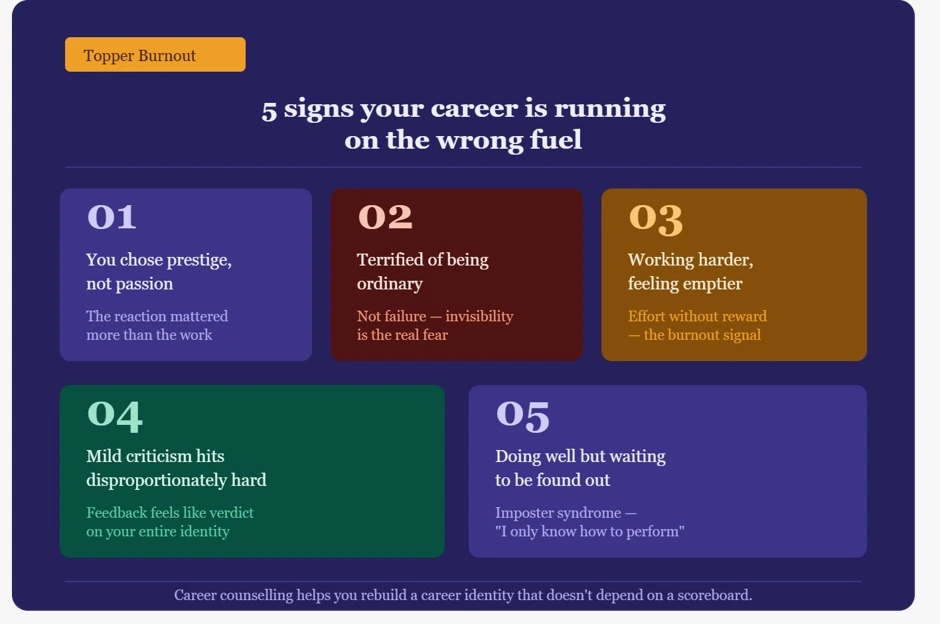
Five signs you are living a topper's career crisis
You chose your career because it sounded impressive, not because it excited you. Medicine. Law. IIT. IIM. These are not bad choices — but if the primary motivation was the reaction you would get when you told someone, that is the topper pattern operating.
You are terrified of being average. Not of failing — of being ordinary. The topper's deepest fear is not inadequacy in a task. It is invisibility. The possibility that without the rank, there is nothing special there at all.
You cannot stop working, but the work brings you no satisfaction. This is the clearest clinical signal of burnout — disconnection between effort and reward. You push harder, produce more, and feel emptier.
Criticism, however mild, hits disproportionately hard. For someone whose self-worth is tied to performance, a single critical comment from a manager does not feel like feedback. It feels like evidence that the whole identity was a lie.
You are doing well but waiting to be found out. Classic imposter syndrome — but in toppers, it has a specific flavour. It is not "I am not good enough." It is "I am only good at performing. And performance is all I know how to do."
What career counselling does for the topper who is burning out
Career counselling for high achievers is a very different conversation from standard career counselling. The problem is rarely a lack of skills or qualifications. The problem is a missing self — an identity that has been entirely outsourced to performance and has never been developed independently of it.
A trained career counsellor working with a burnout-affected topper will typically focus on three core areas:
Values clarification. What matters to you — genuinely, personally, independent of what your parents are proud of or what LinkedIn rewards with impressions? This is harder for toppers than for almost anyone else, because the question itself has been suppressed for so long.
Decoupling identity from performance. Building a stable sense of self that does not collapse under a bad quarter, a missed promotion, or a project that did not land. This is not soft work — it is the most practically protective thing a high-achieving professional can do for their long-term career.
Redefining what success means. Not abandoning ambition — toppers are rarely advised to slow down. But redirecting it toward goals that are intrinsically motivating rather than externally validated. Goals that feel alive when no one is watching.
For further information and personalised career counselling, visit our website — because your career deserves to be built on who you are, not just what you scored.
Conclusion
Being a topper was never just about marks. It was about who you were told you needed to be — and how completely that identity filled the space where a self was supposed to grow. The burnout that follows is not a punishment for working hard. It is what happens when the external scaffolding falls away and there is nothing underneath it.
But underneath it is not nothing. Underneath it is a person who has enormous capacity, real intelligence, and a lifetime of discipline — all of which, redirected toward work that actually means something, produces not just success but satisfaction. Those are different things. And most toppers have never been allowed to learn the difference.
The highest-achieving thing you will ever do might not be scoring 98%. It might be building a career honest enough to sustain you for the next forty years.
Book a personalised career counselling session and start building a career that belongs to you.
Frequently asked questions
What is topper burnout?
Topper burnout refers to the psychological exhaustion and identity collapse experienced by high academic achievers when the external validation system of school and exams ends. Because their self-worth has been built almost entirely around grades, ranks, and recognition, the transition to careers — where success is messier, slower, and less quantifiable — can trigger deep disorientation, numbness, and a loss of direction that looks puzzling from the outside given how capable they are.
Why do toppers often struggle more in careers than average students?
Average students are often more prepared for professional setbacks because they have experienced failure and learned to recover from it. Toppers — particularly those who were shielded from difficulty by parents, teachers, and a system that treated their rank as their worth — frequently arrive at careers without that resilience. Their first real professional difficulty does not just feel hard. It feels like evidence that the whole identity was built on false foundations.
Is academic pressure really affecting career choices in India?
Extensively. India's rank-centric education system — where a student's value is publicly communicated through marks, percentiles, and board results — creates powerful conditioning that shapes career choices long after school ends. Counsellors across the country consistently report that a significant proportion of their clients are high academic achievers who chose their career to satisfy external expectations rather than internal drives, and are paying for that choice in burnout, disconnection, and repeated job changes in their late twenties and thirties.
How is career counselling different from therapy for burnout?
Therapy addresses the clinical dimensions of burnout — persistent exhaustion, depersonalisation, anxiety, depression. Career counselling addresses its practical and identity-based dimensions — values clarification, career direction, the mismatch between who you are and what your work asks you to be. In many cases, both are useful and complementary. A good career counsellor will recognise when clinical support is needed and will refer appropriately, rather than trying to serve both functions alone.
My child is a topper — should I be worried about their career?
Not worried — but watchful. The highest-risk topper is not the one who is struggling. It is the one who appears to be thriving but has never been asked what they actually want, has never been allowed to make a meaningful mistake, and has no idea who they are outside of their performance. The most protective thing a parent can do is to make space for that conversation long before the career crisis arrives — ideally, well before board exams define the relationship between achievement and identity.
Can you recover from topper burnout and build a fulfilling career?
Completely — and often more effectively than people who never experienced it, precisely because the high achiever's underlying capacity is genuine. The work is not about lowering ambition. It is about redirecting it. A topper who develops self-awareness, reconnects with intrinsic motivation, and builds a career around real values rather than external validation does not become less ambitious. They become unstoppable in a way that is actually sustainable.

Leave a Comment
To post comment, please