

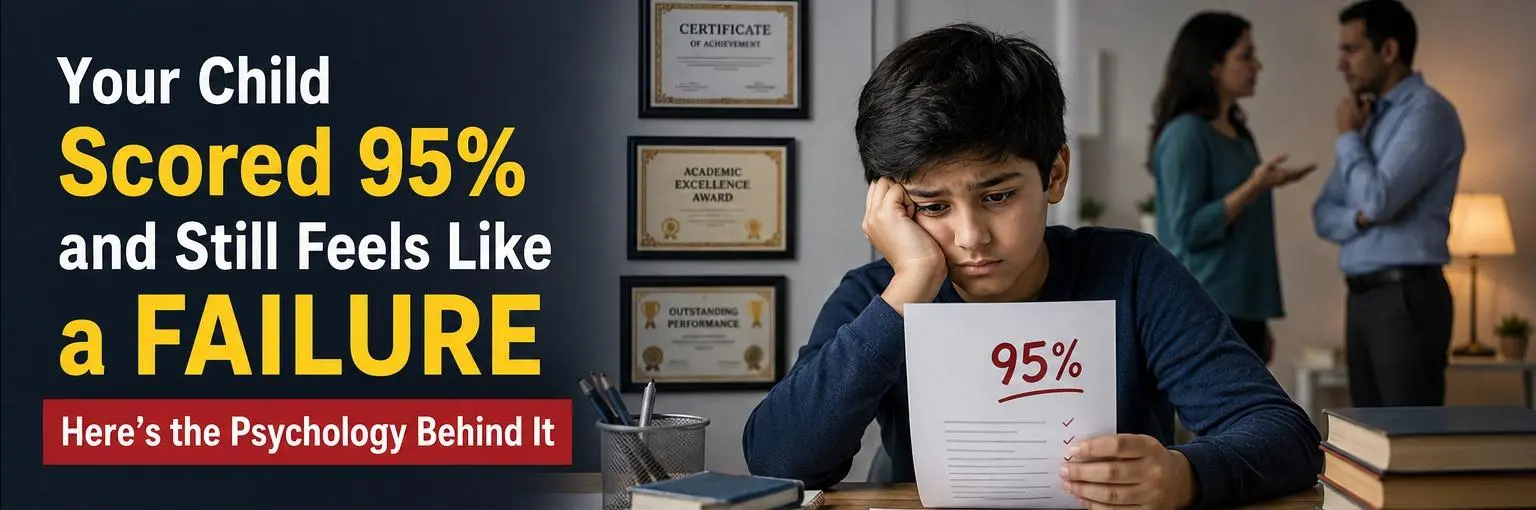
"I got 95%... but I should have scored more."
Many parents hear these words and feel confused.
After all, 95% is an excellent score. Friends congratulate the child. Teachers praise them. Relatives call to celebrate.
Yet the child sits quietly, disappointed, sometimes even crying.
The question is:
How can a child score 95% and still feel like a failure?
The answer lies not in the marks but in the psychology behind achievement, self-worth, and perfectionism.
Today, more students than ever are struggling with an invisible problem: they are succeeding on paper but suffering emotionally.
When Success Doesn't Feel Like Success
For many children, marks have become more than just academic results.
They become a measure of:
- Intelligence
- Worth
- Identity
- Social status
- Future success
Over time, children begin believing:
"If I score high, I am valuable."
"If I make mistakes, I am a failure."
This creates a dangerous mindset where even excellent performance feels insufficient.
A child who expected 98% may see 95% not as an achievement but as proof that they "weren't good enough."
The Psychology of Perfectionism
Perfectionism is one of the biggest reasons high-achieving students struggle emotionally.
A perfectionist child often:
- Sets unrealistically high standards
- Focuses more on mistakes than achievements
- Constantly compares themselves with others
- Feels anxious about disappointing people
- Believes anything less than perfect is failure
In psychology, this is known as maladaptive perfectionism.
Instead of motivating growth, it creates chronic dissatisfaction.
No matter how much the child achieves, they rarely feel successful.
The "Conditional Love" Trap
Most parents genuinely love their children unconditionally.
However, children often interpret praise differently.
Imagine hearing statements such as:
- "We're proud because you scored well."
- "You always come first."
- "Don't lose your rank."
Even when spoken with good intentions, children may begin believing:
"People value me only when I perform."
This is called conditional self-worth.
The child starts attaching their identity to achievements rather than who they are as a person.
As a result, every exam becomes a test of self-esteem rather than learning.
Social Media Has Made Comparison Worse
A generation ago, children compared themselves with classmates.
Today they compare themselves with thousands of students online.
Every day they see:
- Toppers' success stories
- Perfect study schedules
- High scores
- Competitive exam achievements
What they don't see are:
- Failures
- Struggles
- Anxiety
- Burnout
- Rejections
This creates the illusion that everyone else is doing better.
Even a 95% scorer may feel "average" when constantly exposed to unrealistic comparisons.
The Fixed Mindset Problem
According to psychologist Carol Dweck, children often develop either a fixed mindset or a growth mindset.
Fixed Mindset
The child believes:
- Intelligence is fixed.
- Mistakes mean weakness.
- Failure defines ability.
Growth Mindset
The child believes:
- Skills can improve.
- Mistakes are opportunities to learn.
- Effort matters more than perfection.
Children with a fixed mindset often fear losing their "smart student" identity.
Therefore, even a small drop in marks feels like personal failure.
When Achievement Becomes Identity
One of the most common issues seen in career counselling is children introducing themselves through achievements:
- "I'm the topper."
- "I'm the science student."
- "I'm the one who always gets good marks."
But what happens when they don't achieve the expected result?
Their identity feels threatened.
This is why some students experience:
- Anxiety attacks
- Low confidence
- Loss of motivation
- Emotional breakdowns
- Fear of future exams
The problem is not the marks.
The problem is that the child has learned to equate achievement with identity.
A Real-Life Example
Consider two students:
Student A
Scores 95%.
Believes:
"I missed 5%. I disappointed everyone."
Result:
- Anxiety
- Stress
- Self-criticism
Student B
Scores 85%.
Believes:
"I improved by 10% from last time."
Result:
- Confidence
- Motivation
- Satisfaction
The difference is not the score.
The difference is the meaning each child attaches to the score.
What Parents Can Do
1. Praise Effort, Not Just Results
Instead of saying:
"You got 95%, excellent!"
Try:
"I noticed how consistently you studied."
Children should learn that effort matters, not just outcomes.
2. Normalize Mistakes
Talk openly about your own failures and lessons learned.
Children need to understand that mistakes are part of growth, not proof of inadequacy.
3. Avoid Comparing Siblings or Classmates
Comparison may improve performance temporarily but often damages confidence permanently.
Every child has a different learning journey.
4. Separate Marks From Identity
Remind children:
- You are not your report card.
- You are not your rank.
- You are not your percentage.
Academic performance is only one aspect of a person's life.
5. Discuss Multiple Career Paths
Many successful professionals were not school toppers.
The modern world rewards:
- Creativity
- Communication
- Leadership
- Problem-solving
- Adaptability
Marks matter, but they do not determine an entire future.
The Bigger Question
When your child receives 95%, don't ask:
"Why didn't you get 98?"
Instead ask:
"How do you feel about your effort and learning?"
This small shift changes the conversation from performance to personal growth.
And that shift can protect a child's mental health far more than any percentage ever will.
CONCLUSION
A child can score 95% and still feel like a failure because the real issue is rarely the marks themselves. It is often perfectionism, comparison, conditional self-worth, and the belief that achievement defines identity.
As parents and educators, our responsibility is not only to help children succeed academically but also to help them develop resilience, confidence, and a healthy sense of self-worth.
Because a child who learns to value themselves beyond grades is far more likely to thrive in life than a child who learns that perfection is the only acceptable outcome.
Is Your Child's Confidence Becoming Dependent on Marks?
Career counselling and psychological guidance can help children understand their strengths, manage academic pressure, and build a healthy relationship with success and failure.
Book a career counselling session today to help your child discover their potential beyond percentages and report cards.
FAQ
Why does my child cry despite getting good marks?
Many children develop perfectionistic expectations. They focus on what they missed rather than what they achieved, making even excellent results feel disappointing.
Is perfectionism harmful for students?
Healthy striving can be beneficial, but excessive perfectionism is linked to stress, anxiety, low self-esteem, and fear of failure.
Can high-achieving students suffer from anxiety?
Yes. In fact, students who consistently perform well may experience significant pressure to maintain their performance, leading to anxiety and burnout.
How can parents reduce academic pressure?
Parents can focus on effort, learning, and personal growth rather than ranks, comparisons, or percentages alone.
Do marks determine a child's future success?
No. Academic performance is only one factor among many. Skills such as creativity, communication, adaptability, emotional intelligence, and problem-solving also play major roles in long-term success.
When should parents seek professional counselling for their child?
If a child shows signs of excessive stress, fear of failure, low self-esteem, emotional breakdowns, or persistent anxiety related to academics, consulting a psychologist or career counsellor can be beneficial.

Leave a Comment
To post comment, please